


 CN


Against the wave of digitalization in high-end manufacturing, the global industrial inkjet market is growing steadily. According to QYResearch, the global picoliter-level piezoelectric inkjet printhead market was approximately USD 889 million in 2025 and is expected to reach USD 1.446 billion by 2032, with a CAGR of 7.2%. Functional inkjet applications are growing faster than traditional printing and have become a core driver of industry expansion.
If the first half of inkjet printing was about replacing traditional screen printing, pad printing, and offset printing to complete the reproduction and output of graphics and colors, then the second half is about opening a new digital manufacturing path and achieving precise deposition of functional materials. Special materials such as conductive layers, insulating films, functional coatings, sensing materials, and even perovskite precursors can all be precisely formed through inkjet processes, continuously releasing value in frontier fields such as lithium batteries, photovoltaics, semiconductors, printed electronics, automotive interiors, and biomedicine.
Collaborative innovation among printheads, inks, and substrates cannot do without mature and reliable full-stack solution support, which is also the core area Hosonsoft has been deeply cultivating.
I. Essential Difference Between Two Types of Inkjet: Image Inkjet vs. Functional Inkjet
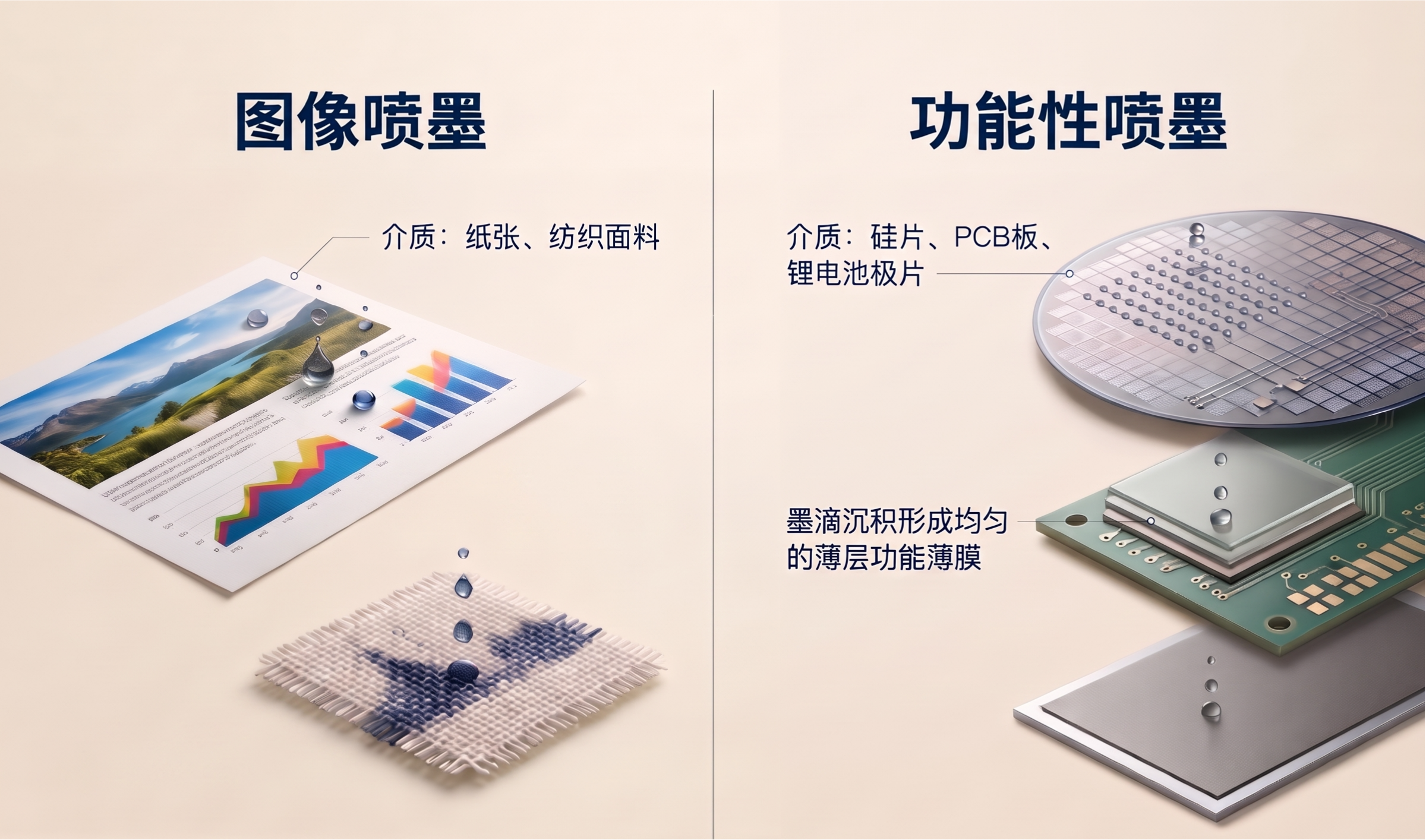
Conventional image inkjet technology relies on piezoelectric printheads, jetting micron-level ink droplets onto media surfaces at tens of thousands of times per second, and uses pigments or dyes to achieve color reproduction, with the core goal of image effect.
The core of functional inkjet printing is to compound functional components such as conductive particles, insulating media, temperature-sensitive materials, and bioactive components into ink systems, and precisely deposit them onto diverse substrates such as silicon wafers, glass, metal, flexible films, PCB substrates, and lithium battery substrates. The core differences are clear:
(1)Ordinary image inkjet: targets color reproduction and visual display; evaluated by color gamut, sharpness, and image uniformity; substrates are mostly paper, fabric, and advertising materials; the core requirement is "look good when printed";
(2)Functional inkjet: targets specific physical, electrical, and chemical functions; evaluated by film thickness consistency, alignment accuracy, film formation stability, and batch repeatability; substrates are mainly industrial substrates such as glass, silicon wafers, metal, PCB, and battery electrodes; the core requirement is "usable, stable, and mass-producible".
This "printing is function" characteristic drives inkjet technology from two-dimensional graphic output to functional thin films, three-dimensional structure formation, and even dynamic response functions.
II. Economic Advantages of Functional Inkjet
In various industrial manufacturing scenarios, leveraging digital fluid deposition, functional inkjet has significant advantages over traditional analog processes such as coating, evaporation, etching, and screen printing in flexible production and overall cost:
(1)Flexible production, reducing trial-and-error and inventory costs: Digital inkjet supports independent setting of patterns and deposition parameters, enabling one-piece-one-version and multi-spec mixed-line production without plate making, eliminating plate-making investment, reducing finished product inventory, shortening new product introduction cycles, and meeting manufacturing needs of small batches and multiple varieties.
(2)Precise deposition, stabilizing batch yield and reducing costs: Digital deposition has good predictability and reproducibility; ink droplet landing positions and material deposition amounts are precisely controllable, improving the poor consistency of traditional analog processes; it also eliminates screens, fixtures, and multiple supporting post-processing steps, allowing one equipment set to be compatible with multiple products, improving process integration, shortening production lead times, and helping factories move toward green and efficient manufacturing.
However, the industrialization of functional inkjet depends on the collaboration of multiple subsystems such as boards, control software, vision positioning, ink supply, and UV curing. Upgrading only one part of the hardware cannot fully realize the technical value of functional inkjet.
III. Full Landscape: Frontier Application Map of Functional Inkjet
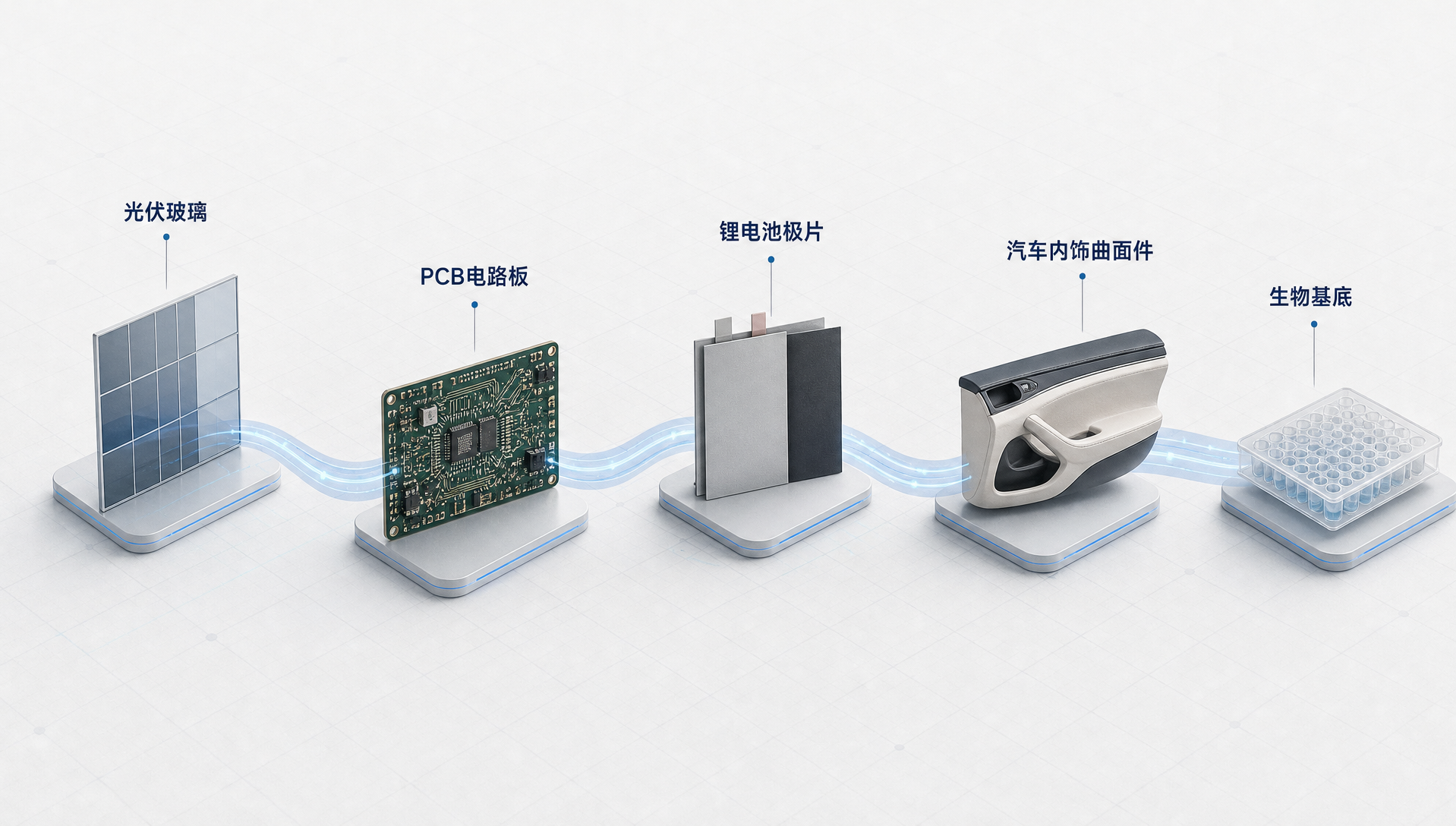
Leveraging the unique capability of digital deposition, functional inkjet printing has achieved key breakthroughs in multiple frontier industrial tracks, and its application map continues to expand: printed electronics (flexible circuits, RFID antennas, sensing units), biomedicine (biological scaffolds, functional coatings), photovoltaics and perovskite (insulating layers, light-absorbing layers), new energy lithium batteries (battery insulating blue films, protective coatings), PCB and semiconductors (solder resist, photoresist, nanoimprint materials), automotive interior CMF (integrated texture and functional coatings for curved and special-shaped parts), ceramics and glass (large-format high-speed production and weather-resistant functional coatings), etc.
IV. What Are the Core Challenges in Implementing Functional Inkjet?
Although functional inkjet has broad prospects, its industrialization still faces three major core technical challenges:
(1)High difficulty in multi-system integration:
Functional inkjet is a complex system engineering involving printhead drive, control boards, RIP image processing, vision positioning, ink supply, UV curing, and industrial control units from different suppliers. Software and hardware protocols are not unified, integration and debugging cycles are long, and mass-production stability is difficult to guarantee.
(2)High threshold for precision and consistency control:
Micron-level alignment, ink droplet volume control, film thickness uniformity, and roll-to-roll/sheet-to-sheet line speed matching are demanding. Any drift in any link may directly cause functional defects such as insulation failure, circuit defects, and uneven coating.
(3)Difficult process accumulation and replication:
Process parameters in the proofing stage are highly dependent on engineer experience and need to be re-debugged after changing substrates or ink batches; from proofing to mass production and from single machine to full-line expansion, process parameters are difficult to replicate quickly, bringing yield fluctuation risks.
V. Hosonsoft Full-Stack Solution: One-Stop Connectivity of the Functional Inkjet Chain
Based on the innovative applications of mainstream industrial printheads such as Ricoh, Epson, Kyocera, Xaar, Seiko, and Konica in functional inkjet, Hosonsoft serves key industrial tracks including new energy, semiconductors, automotive, panels, and printed electronics, providing an integrated full-stack inkjet solution of "boards + inkjet control + RIP software + vision positioning + ink supply system + industrial PC + UV lamp", with corresponding capabilities for the three major challenges above:
(1)For multi-system integration:
Deliver integrated full-stack delivery through a modular hardware and software architecture, with unified software and hardware protocols. Drawing on years of mass-production control experience in mature printing tracks such as textiles and advertising, Hansen has developed a self-developed functional inkjet control architecture that balances large-format high-speed continuous inkjet and micron-level high-precision processing; software and hardware modules can be flexibly selected according to customer substrates, functional inks, and production line modes, and combined on demand to build production lines.
(2)For precision and consistency control:
Achieve full-link collaborative control of image algorithms, CCD vision calibration, ink supply, and curing units, ensuring film thickness, alignment, and film formation stability under complex working conditions and supporting stable mass production.
(3)For process accumulation and replication:
With mature mass-production experience and a modular architecture, support rapid replication of process parameters. The solution is compatible with mainstream industrial printheads, not bound to a single brand, and opens SDK for secondary development by equipment manufacturers and integrators, helping full-process implementation from proofing and trial production to mass-production expansion.
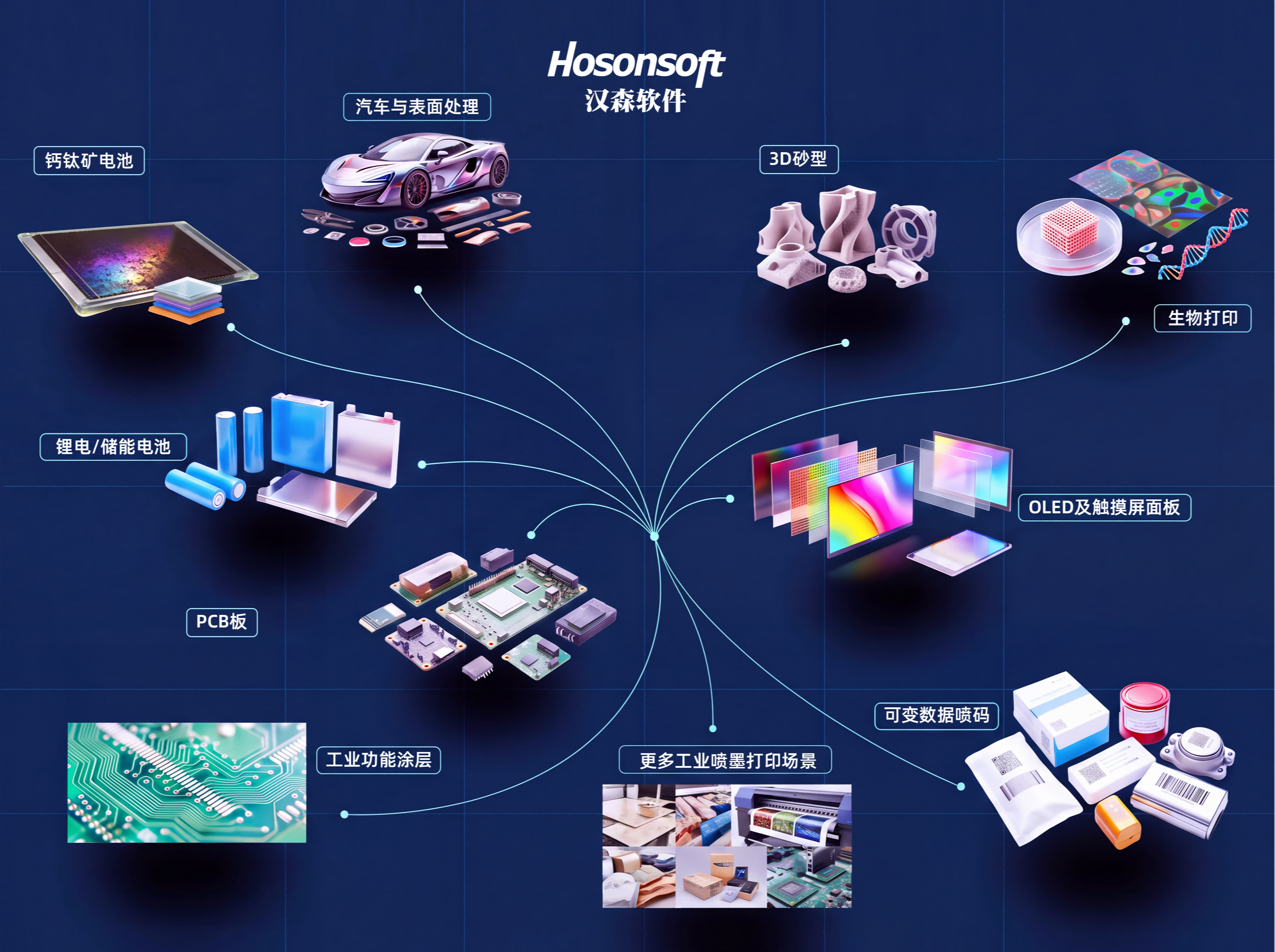
At present, Hosonsoft solutions have been successfully applied in printed electronics, biomedicine, photovoltaic perovskite, new energy lithium batteries, PCB and semiconductors, automotive interior CMF, ceramics and glass, and other tracks.
VI. Industry Outlook: Full-Stack System Is the Mass-Production Foundation of Functional Inkjet
Whether for performance upgrading, cost optimization, or building green and low-carbon production lines, functional inkjet contains huge industrial potential. Functional inkjet has much higher requirements for droplet control, film formation consistency, and batch reproducibility than traditional graphic printing. A stable and replicable full-stack digital system is the core foundation for mass production.
Shenzhen Hosonsoft Co., Ltd. has been deeply engaged in the inkjet control field for nearly 20 years and is a national-level specialized and sophisticated "Little Giant" enterprise. With self-developed boards, inkjet control, RIP software, and CCD vision positioning as its core, the company delivers integrated core components including ink supply, industrial PC, and UV lamp; it is compatible with mainstream printheads such as Epson, Kyocera, Ricoh, Xaar, Seiko, and Konica, covering packaging, labels, book POD, textiles, ceramics, 3D full color, PCB, semiconductors, lithium batteries, perovskite, and other tracks, and supports full-process implementation from proofing and trial production to mass-production expansion. The solution is fully domestically autonomous and controllable, has EU CE certification, and opens SDK for secondary development.
Relying on cross-track reusable underlying inkjet capabilities and rich mass-production experience, Hosonsoft helps equipment manufacturers and integrators quickly enter the new functional inkjet track and is a preferred partner for deploying functional inkjet.
 Back


