


 CN


According to industry research institutions, in 2025 the domestic 3D sand printing market is expected to grow 23%–25% year on year, significantly higher than the 6% growth of traditional casting equipment; the global market is expected to grow from USD 770 million in 2025 to USD 1.9 billion by 2032.
The digital replacement of the casting industry is moving from proof of concept to production-line-level procurement.
Traditional sand casting relies on wooden and metal molds, with prominent pain points: mold lead times of 15–90 days and high costs, making small and mixed orders difficult to accept; demolding constraints limit the forming of complex cavities and integrated thin-walled structures; production depends on experienced masters, changeovers are troublesome, yield fluctuates greatly, and standardization is difficult to implement.
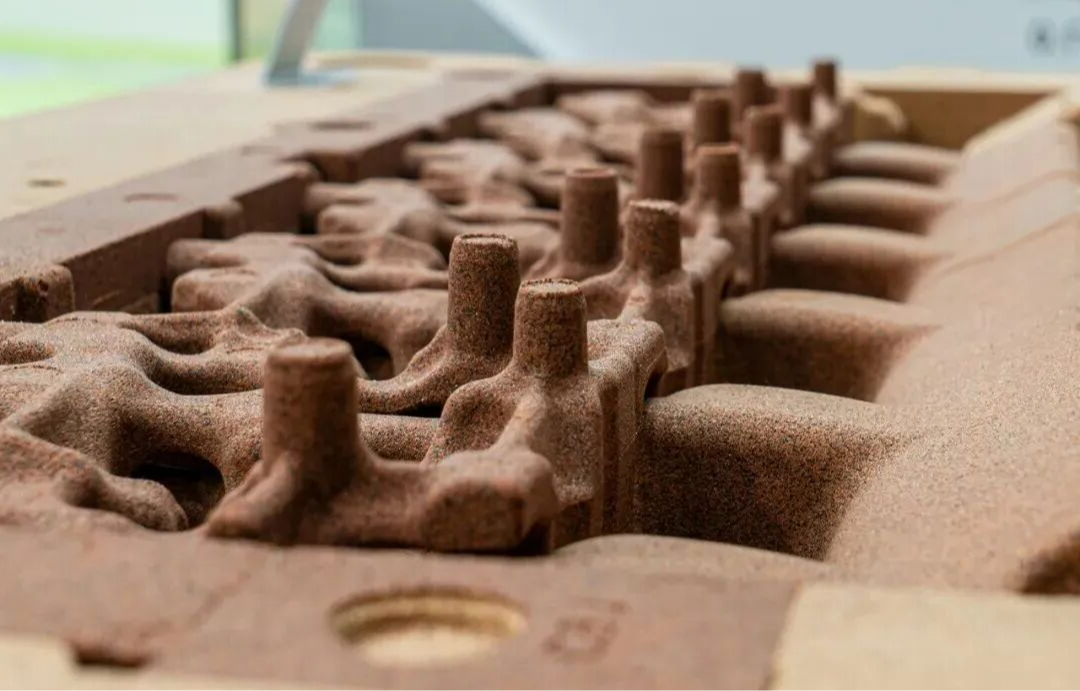
3D sand printing based on binder jetting is changing equipment selection and order structures on casting production lines.
I. Market Outlook: Why 3D Sand Printing Is Accelerating
Sand casting is one of the oldest processes in manufacturing, and more than 70% of global casting output is produced by sand casting. For a long time, the growth engine of this industry has been “scale” and “labor,” not “efficiency” and “precision.”
The change occurred after three variables matured simultaneously:
First, printhead and material costs have declined. The domestic production and multi-functionalization of industrial piezoelectric printheads have moved binder jetting (BJ) from the laboratory to mass-production lines. The supply chain for 3D-printing-specific sand materials such as furan resin and curing agents is also gradually maturing.
Second, downstream demand is forcing flexible production. Scenarios such as automotive lightweighting, complex aerospace structural parts, and rapid mold trial production have increasingly strong demand for “low volume, complex structures, and fast delivery.” Traditional casting relies on mold making, and the development cycle for a sand mold is 60–90 days, making it impossible to handle such orders at all.
Third, policies are driving green transformation. The casting industry is a typical energy-intensive and high-emission industry. Mold-free manufacturing reduces wood mold consumption and manual molding steps, aligning with the intelligent and green transformation direction of manufacturing.
The combined result of these three variables is that 3D sand printing is no longer just a supplementary business for “print service centers,” but is becoming a new production-line direction for equipment manufacturers.
II. Pain Point Breakdown: Where Traditional Casting Gets Stuck in Four Areas
Pain Point 1: High mold costs and long lead times
Traditional casting requires wooden or metal molds first. The mold development cycle for a complex sand mold is usually 60–90 days, with high mold material costs, high maintenance costs, and low reuse rates. For low-volume orders, mold opening alone causes a loss, so companies dare not accept scattered orders.
Pain Point 2: Precision depends on manual experience
Sand mold compactness, parting surface alignment, and sand core assembly are highly dependent on skilled workers. Worker shortages directly limit capacity, while uneven surface roughness and low pass rates for complex cavities caused by manual sand filling further push up post-processing costs.
Pain Point 3: Complex structures cannot be made
Traditional sand casting is limited by parting design. Complex cavities must be split into multiple sand cores and assembled, and seams are high-incidence areas for casting defects. Product design is constrained by the process, making advanced structures such as lightweighting and conformal cooling channels difficult to implement.
Pain Point 4: Weak flexible production capability
Traditional production lines have slow changeovers and heavy inventory, and the production scheduling cost for high-mix, low-volume orders is extremely high. Once market demand fluctuates, there will be either inventory backlog or order delays.
III. Hosonsoft 3D Sand Printing Solution: Using Digital Inkjet to Solve Traditional Casting Pain Points
3D sand printing uses the binder jetting (BJ) digital inkjet process, and the principle is not complicated: spread a layer of sand, the inkjet printhead jets binder according to slice data, cure one layer, repeat sand spreading, jetting, and curing, and build layer upon layer, directly forming a sand mold “from nothing to something.”
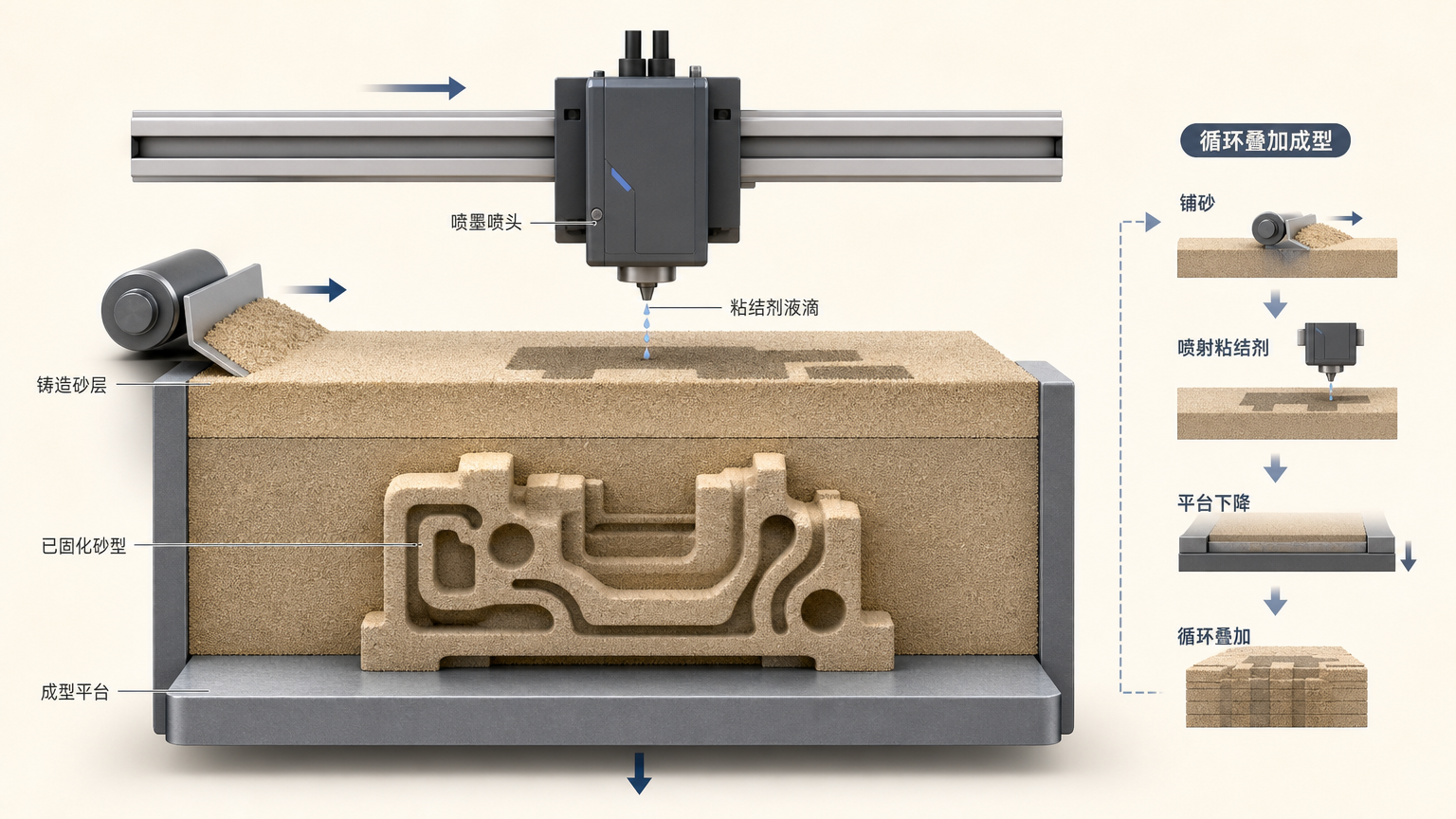
Hosonsoft 3D sand printing solution integrates in-house boards + inkjet control + 3D slicing software + core components (ink delivery system, etc.), with a full-stack control solution at its core and an open SDK to support deep integration by manufacturers, specifically targeting four major bottlenecks in traditional casting:
1. Mold-free production, greatly compressing delivery cycles
No wooden or metal molds are required; CAD digital models directly drive printing. Complex sand molds can be completed in hours, eliminating the high costs of mold development, maintenance, and replacement. Small and mixed orders can also be easily accepted, and delivery cycles are shortened from months to hours.
The solution can precisely control printhead motion trajectories and jetting frequencies. Combined with in-house boards and motion control capabilities, it precisely controls layer thickness and position layer by layer. Under typical sand materials and process windows, sand mold dimensional accuracy can reach ±0.3 mm. The full process of sand spreading, jetting, and curing is automated; the system monitors jetting status, ink-path pressure, and motion accuracy in real time and performs dynamic adaptive parameter adjustment, avoiding fluctuations caused by manual operation, ensuring consistent quality in batch production, and reducing downstream machining allowance.
3. Unleash design freedom with integrated forming of complex structures
Free from parting, draft, and demolding constraints, the in-house 3D slicing software performs dedicated path optimization for labyrinth channels, conformal cooling channels, and thin-walled irregular cavities. Structures difficult to achieve with traditional processes can be printed and formed in one piece, greatly relaxing design constraints imposed by casting processes.
4. Flexible continuous production for easy high-mix output
Changeover only requires switching digital files, with no need to remake molds. It supports 24-hour continuous printing, adapts to high-mix, low-volume orders, and effectively reduces inventory pressure.
Currently, it has been deployed in sand printing scenarios such as toys and figurines, building materials, medical materials, and aerospace.
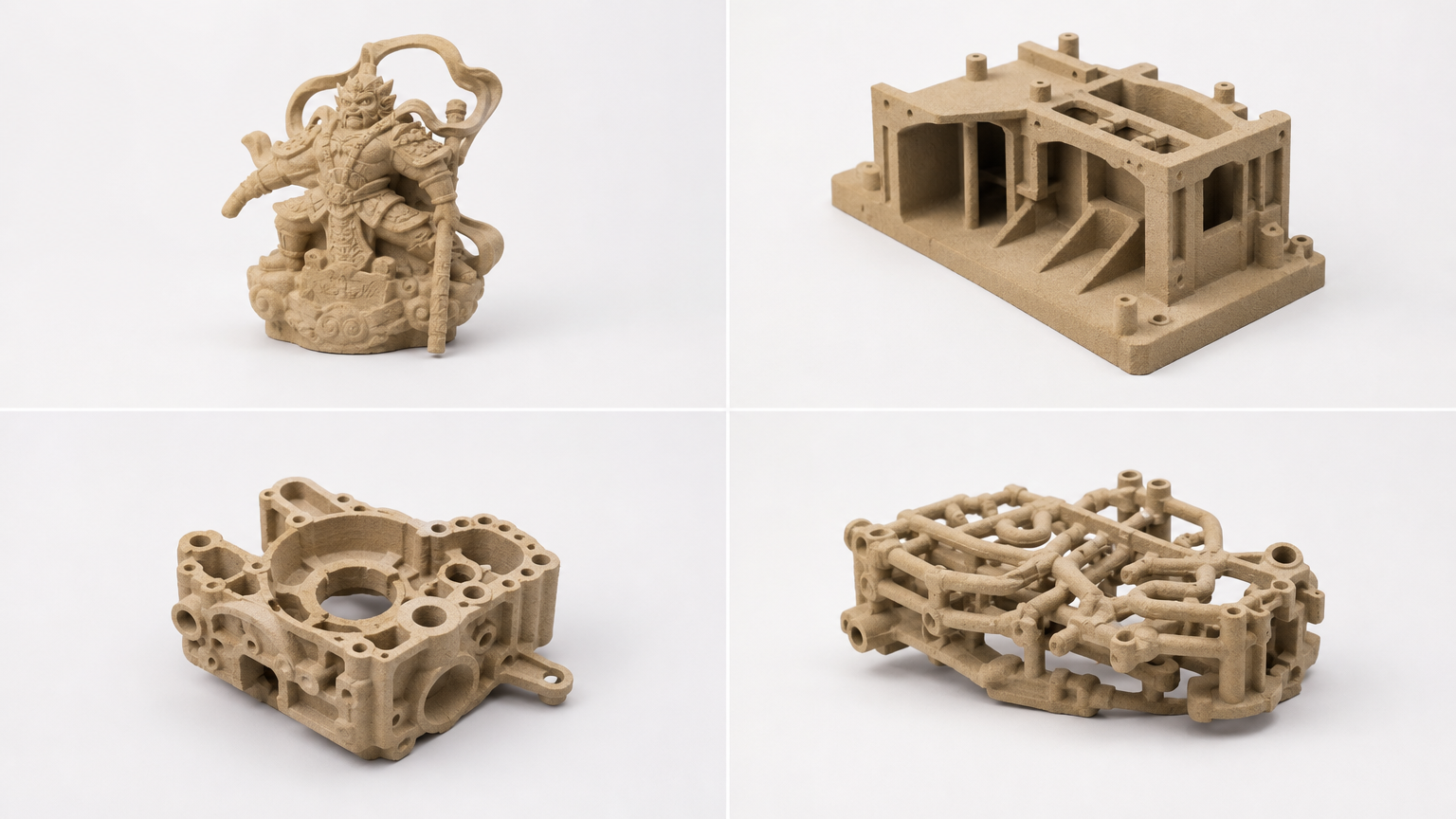
3D sand printing is not only a new manufacturing path for the casting industry; it is also reshaping the casting production paradigm through digital inkjet technology.
When mold constraints are broken and the uncertainty brought by manual experience is replaced by digital control, the casting industry can fully unleash design freedom and confidently take on low-volume, high-complexity, fast-delivery orders. With industrial inkjet control at its core, Hosonsoft continuously delivers stable and reliable end-to-end solutions, helping equipment manufacturers avoid detours in control-layer debugging and working with partners to jointly promote the intelligent and green upgrading of the casting industry.
Shenzhen Hosonsoft Co., Ltd.
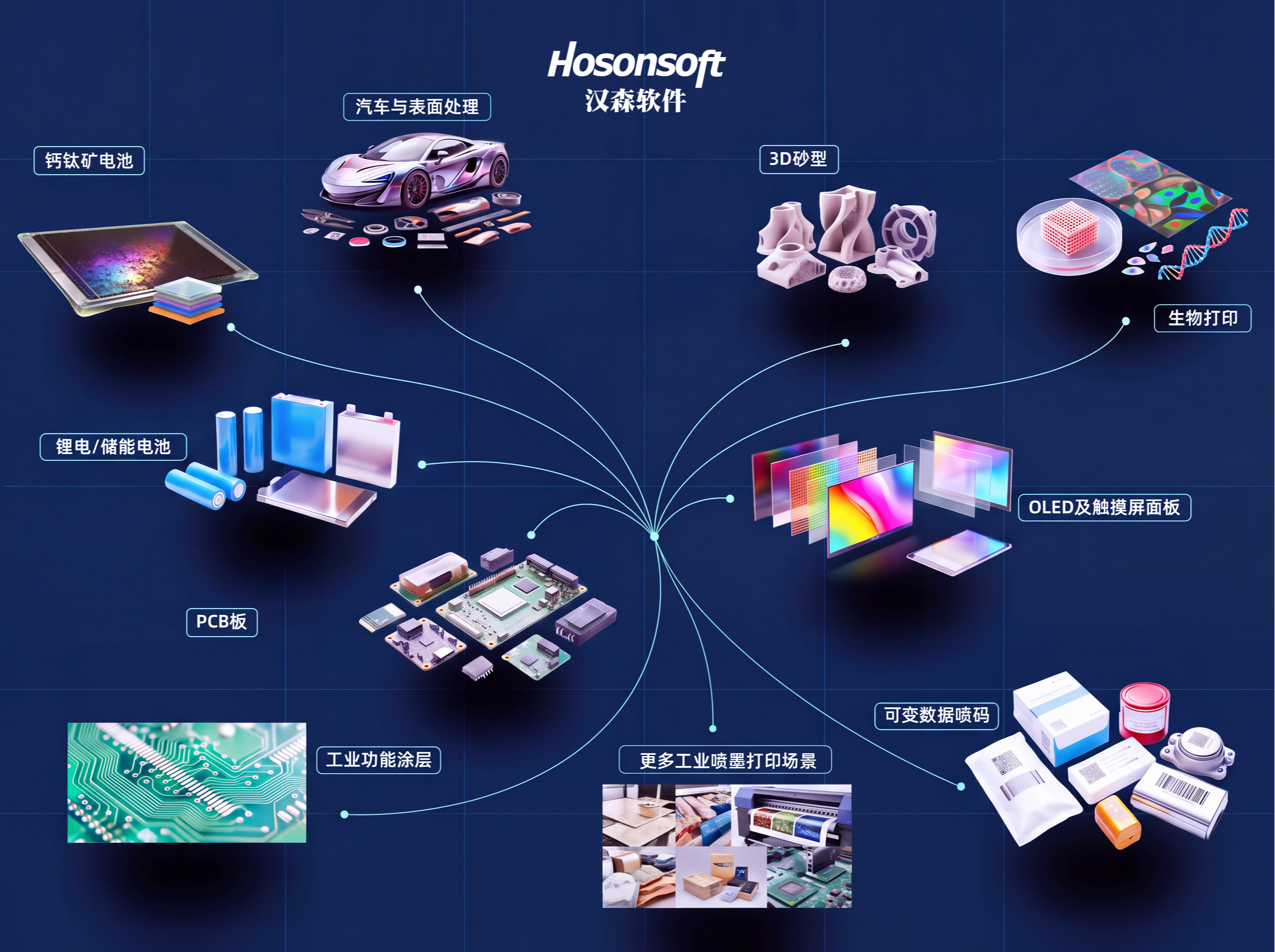
Founded in 2006, the company is a full-chain digital printing solutions provider in the industrial digital inkjet printing field. As the world's largest independent print control system supplier, it focuses on control systems, RIP software, SaaS platforms, and matching inks, building a full-industry-chain layout covering core components, software, cloud services, and consumables. The company holds more than 430 authorized patents, and its business covers more than 100 countries and over 20 industries worldwide. Its solutions have been widely implemented in textile, packaging, 3D printing, advertising, labels, lithium batteries, photovoltaics, semiconductors, biomedical, and many other industries. The company is committed to providing B2B customers with end-to-end, scalable, integrated printing solutions.
 Back


