


 CN


Under the new energy wave, cockpit personalization has become a key differentiator for OEMs, and interior CMF demand is shifting from high-volume standardization to multi-SKU, small-batch, and rapid-iteration production. Traditional processes such as water transfer printing, heat transfer printing, and spray painting have long been constrained by curved-surface texture distortion, high design-change costs, and environmental pressure. As printheads and robotic hardware mature, curved-surface digital inkjet direct printing is accelerating toward production-line validation. For equipment manufacturers, production-ready curved-surface mapping and vision-tracking inkjet control solutions are the key to implementation.

I. Market Trend: Automotive Interior CMF Is Entering a Window for Process Transformation
OEM demand for cockpit personalization continues to surge, forcing the interior supply chain to re-examine surface treatment processes. Industry changes are concentrated in four directions:
1. Demand Side: Orders Are Shifting Toward Small Batches and Multiple SKUs
In the past, a single texture could be mass-produced in tens of thousands of units. Today, custom, limited-edition, and themed cockpit orders often range from only a few hundred to a few thousand units per batch. The tooling costs of traditional transfer films and masking jigs are difficult to amortize.
2. Process Side: Complex Curved Surfaces Plus Strict Testing Are Reaching the Limits of Traditional Processes
Door panels, instrument panel trim, helmets, and other multi-curvature, high-drop irregular parts are difficult to process. Combined with OEM requirements for strict wear resistance, weather resistance, and chemical resistance testing, quality risks such as easy tearing of transfer films and easy peeling and fading of spray coatings are prominent.
3. Supply Chain Side: Hardware Is Mature, While Software Has Become the Production Bottleneck
Industrial high-drop printheads, six-axis robots, and vision hardware have already been commercialized, but curved-surface inkjet control solutions with full-chain production capability remain scarce, and the local service response cycles of overseas solutions are also relatively long.
4. Track Positioning: An Incremental Supplement, Not a Wholesale Replacement
For high-volume solid-color interior parts, spray painting remains mainstream. Curved-surface inkjet focuses on mid-to-high-end customization, limited editions, complex curved-surface parts, and rapid prototyping. Completing process validation early can secure a first-mover advantage.
II. Traditional Processes vs. Curved-Surface Digital Inkjet: Understanding the Underlying Process Differences
Water transfer printing, heat transfer printing, and spray painting all require transfer films and tooling jigs to be prepared in advance. They follow a "prepare auxiliary materials first, then perform surface processing" logic, resulting in a long design-change chain and insufficient flexibility.
1. Water Transfer Printing
Advantages: Good curved-surface adaptability and mature texture reproduction
Pain points: Custom film plate-making and film output usually take 7–15 days, with even longer cycles for complex textures, resulting in high design-change costs; texture stretching and distortion occur at high-curvature positions; the film layer is prone to wear and cracking; design changes cause long downtime, making small batches uneconomical.
2. Heat Transfer Printing
Advantages: Stable color, and on some hard substrates, film integrity is better than that of water transfer printing
Pain points: Poor adaptability to complex curved surfaces; ghosting and edge whitening easily occur at recesses and corners; at sharp corners, ink is easily stretched thin, causing incomplete textures; every texture requires a custom transfer film; sampling and design-change cycles are long.
3. Masking Spray Painting
Advantages: Suitable for high-volume solid-color parts, with strong hiding power
Pain points: Sagging, orange peel, and color differences easily occur; overspray loss is usually above 30%, and even higher for complex curved-surface parts; masking jigs are costly; VOC control is strict and environmental assessment thresholds are high; coatings are prone to peeling and fading, and multi-texture switching is very slow.
Core Advantages of Curved-Surface Digital Inkjet Direct Printing
Curved-surface digital inkjet eliminates pre-processes such as film making and jigs. CAD textures are directly mapped onto the workpiece surface, combined with visual positioning and robot-following printing:
1. No transfer film or masking jig is required; textures can be switched within minutes, supporting rapid sampling and design changes;
2. Adapts to high-drop complex curved surfaces such as door panels, instrument panels, and helmets, automatically correcting texture distortion caused by curvature;
3. Digital control of ink volume and color parameters, supporting ΔE color-difference control and batch consistency traceability according to OEM requirements;
4. On-demand inkjet with low material loss; UV inkjet greatly reduces hazardous waste and VOC emissions;
5. Full retention of production data, with work orders, parameters, and batches bound together to meet OEM traceability audits.
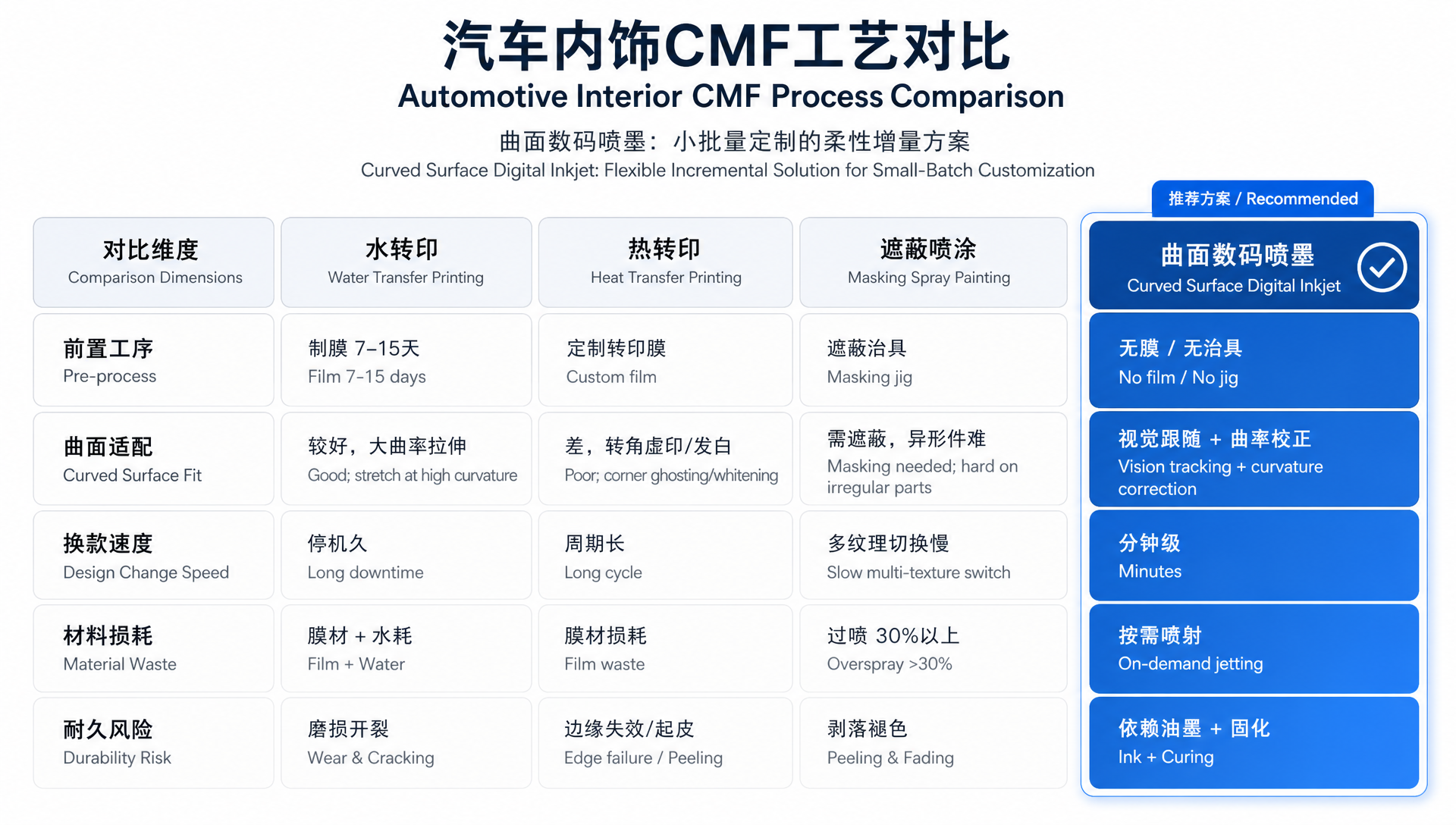
Inkjet is not intended to replace traditional processes, but to provide interior CMF with a new flexible process route that addresses personalized, small-batch, and rapid-iteration needs that traditional processes cannot solve.
III. One Solution Covering Multiple Types of Complex Curved-Surface CMF Needs
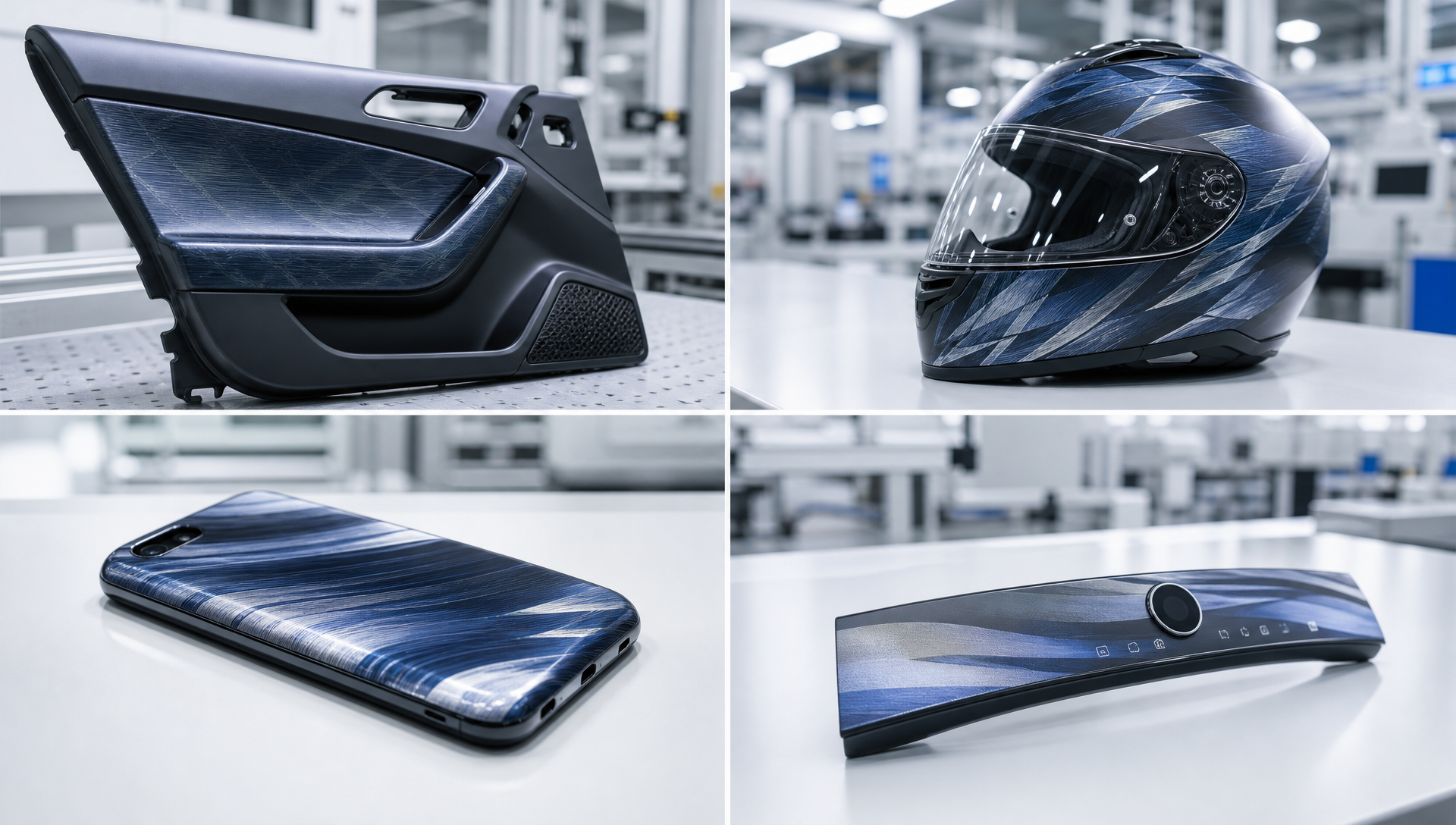
1. Automotive interior parts: door panel decorative trim, center console trim strips, armrest covers, instrument panel decorative panels, cockpit personalized trims, and limited-edition interior components;
2. Helmet category: motorcycle helmets and electric riding helmets. They also involve complex curved-surface CMF, and the process logic is fully aligned;
3. Cross-track expansion: 3C curved-surface housings and irregular decorative panels for high-end home appliances.
IV. Equipment Manufacturer Selection Guide: How to Choose an Inkjet Control Solution Provider
Being able to drive a printhead does not equal a qualified inkjet control solution. Whether it can pass production approval is the core threshold. The following six selection dimensions are for reference:
1. Curved-Surface Mapping and Vision Tracking
Does it support curved-surface unwrapping, UV texture mapping, six-axis robot linkage, high-drop following, and corner distortion correction?
Many flatbed inkjet solutions only perform simple coordinate conversion. At the corners of high-curvature workpieces, texture stretching and distortion easily occur. Samples may look good, but mass production is prone to batch defects.
2. Printhead Ecosystem Compatibility and Openness
Can it be compatible with mainstream industrial printheads such as Ricoh? How open is the SDK? Does it support integration with self-developed motion systems and robot platforms?
Some solutions are bound to a single printhead model. Subsequent replacement of the printhead platform requires replacing the entire software suite, resulting in high modification costs.
3. Digital Closed-Loop, Color Control, and Traceability Capabilities Adapted to the Automotive Supply Chain
Does it support work order binding and automatically record printing parameters, ink volume, and batch information? Does it have color version management and color-difference control capabilities to meet OEM traceability audit requirements?
Many printhead drive solutions are only responsible for ink ejection, lacking production process and log management, and have no work-order traceability capability, making them prone to obstacles during Tier 1 audits.
4. Ink Authorization, Process Encryption, and Anti-Diversion Capabilities (Evaluated by Business Model, Not a Mandatory Technical Item)
If a manufacturer plans to deliver a production line under the "equipment + designated ink" model, ink, equipment, and distributor ID binding, offline verification, and tamper-proof capabilities are worth including in the evaluation. This is not a mandatory technical item for a control solution, but it affects the controllability of the long-term consumables ecosystem. Without an authorization control mechanism, inferior or diverted ink is difficult to identify. Once ink quality becomes abnormal, quality risks will be transmitted to equipment manufacturers and parts suppliers.
5. Mass-Production Implementation Services and Process Support Capabilities
In addition to software delivery, can the provider support ink debugging, sample proofing, durability testing, and continuous iterative optimization?
Overseas solutions have long local service response cycles; some domestic suppliers only deliver software and hardware and are unfamiliar with CMF surface processes, leaving production-line debugging challenges to be borne by the equipment manufacturer.
6. Independent Controllability, Compliance, and Long-Term Iteration Capabilities
Is the solution domestically developed and independently controllable? Does it provide compliance support such as CE, stable version updates and maintenance, and avoid supply-chain cutoff risks?
Relying on overseas underlying solutions introduces supply-chain uncertainty, and subsequent feature iteration and fault maintenance are easily constrained.
Selection summary: When choosing a control solution partner, equipment manufacturers should prioritize suppliers with full-chain digital capabilities, not merely printhead drive service providers.
Curved-surface digital inkjet will not completely replace mature processes such as spray painting and water transfer printing, but it is a flexible incremental solution that cannot be ignored in the personalized automotive interior CMF track. The earlier process validation is completed and the software-hardware closed loop is established, the greater the chance of obtaining an "entry ticket" in the new wave of cockpit customization.
Shenzhen Hosonsoft Co., Ltd.
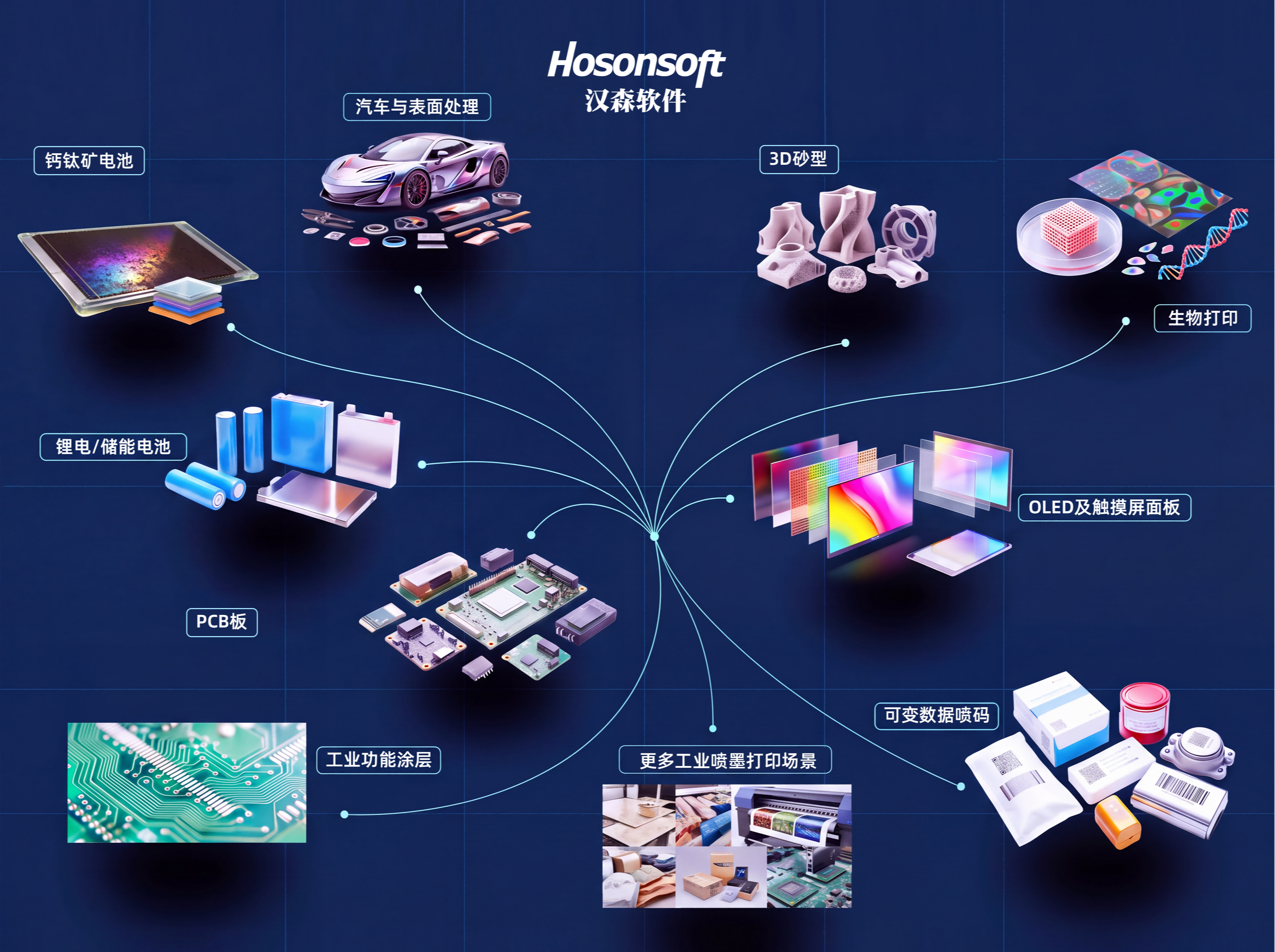
Founded in 2006, the company is a full-chain digital printing solutions provider in the industrial digital inkjet printing field. As the world's largest independent print control system supplier, it focuses on control systems, RIP software, SaaS platforms, and matching inks, building a full-industry-chain layout covering core components, software, cloud services, and consumables. The company holds more than 430 authorized patents, and its business covers more than 100 countries and over 20 industries worldwide. Its solutions have been widely implemented in textile, packaging, 3D printing, advertising, labels, lithium batteries, photovoltaics, semiconductors, biomedical, and many other industries. The company is committed to providing B2B customers with end-to-end, scalable, integrated printing solutions.
 Back


