


 CN


The glass deep-processing industry has long relied on traditional processes such as screen printing, film lamination, sandblasting and magnetron sputtering. As industrial inorganic inks, precision printheads and digital control technologies continue to mature, digital inkjet has long moved beyond the stereotype of “just printing patterns.” From architectural ceramic frit and automotive glass markings to the formation of functional layers such as conductive circuits and anti-slip dot matrix, this plate-free precision deposition process is opening up entirely new product innovation space for glass deep processing.
I. What Is Industrial Digital Inkjet Printing?
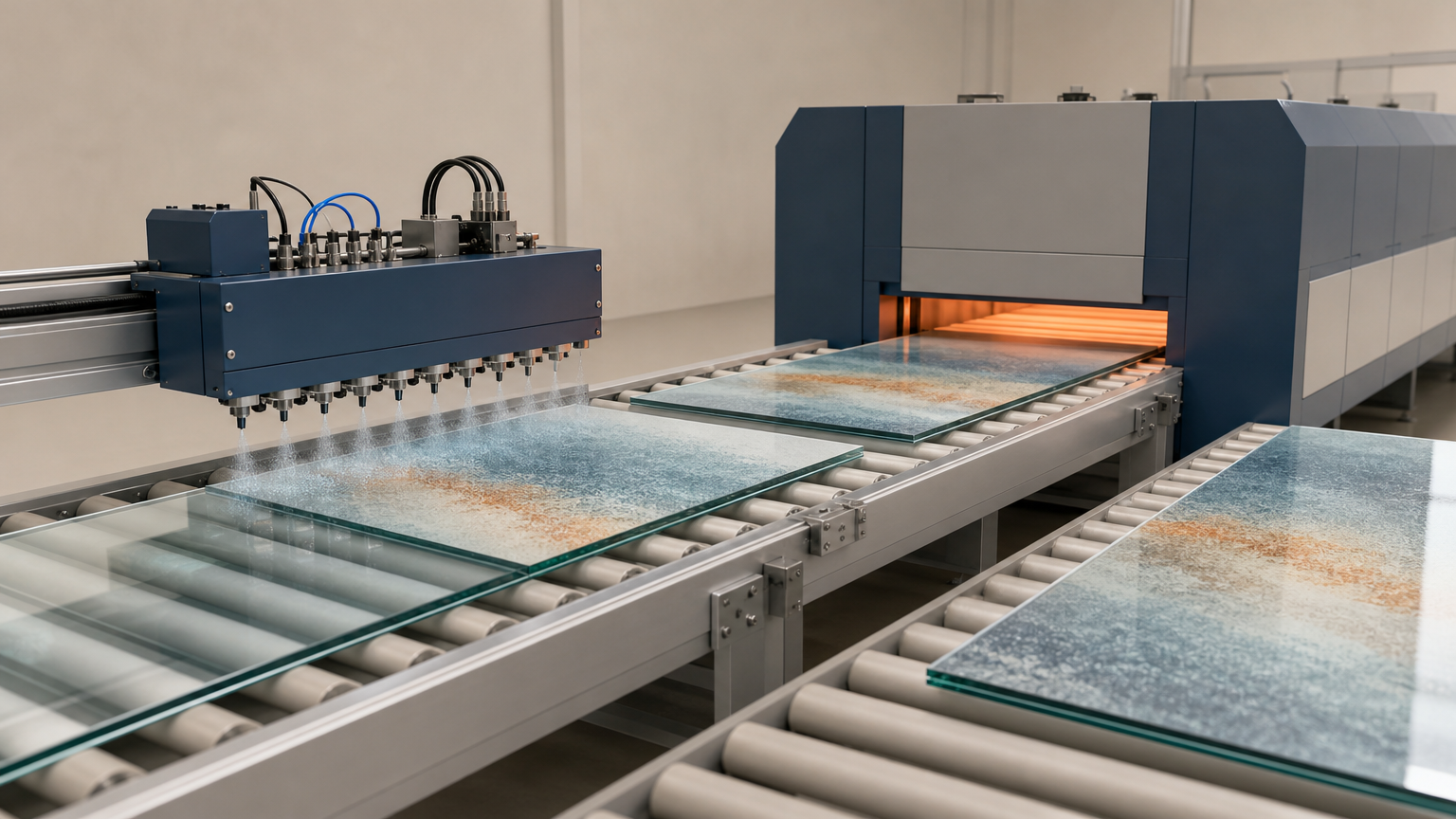
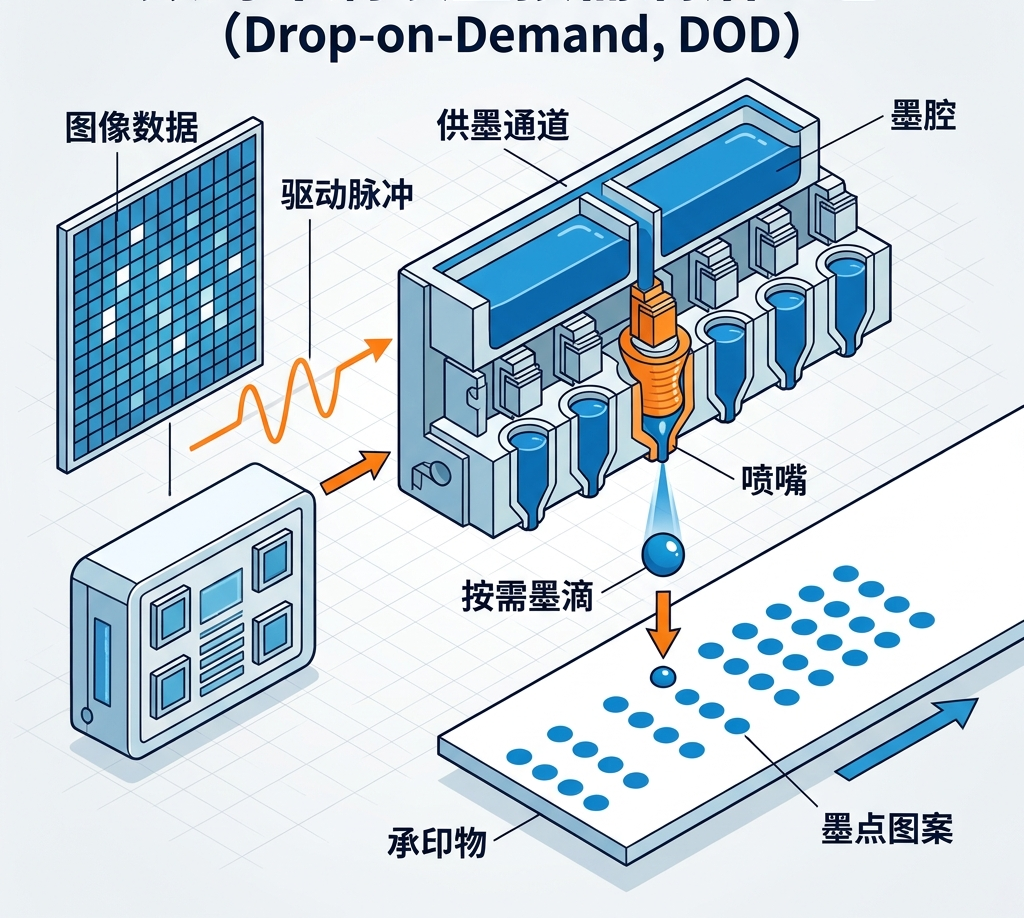
Industrial digital inkjet printing is a non-contact digital deposition technology. Driven by electrical signals to piezoelectric printheads, it controls droplet ejection on demand, requires no screens/stencils, and directly defines patterns, ink volumes and layouts from digital files. It is flexible, controllable and capable of variable output.
In glass deep-processing applications, this process is used with inorganic glazes and functional pastes: the paste is precisely deposited on the glass surface and then enters the tempering furnace together with the glass. After high-temperature sintering at approximately 650–720°C, the ink components fuse with the glass substrate to form a stable coating that is scratch-resistant, weather-resistant and resistant to delamination and fading. Its core advantage is digital flexible production: patterns and process parameters are file-driven, single-piece differentiated output is supported within a single batch, and the minimum production unit can be as small as one sheet of glass.
II. Decorative Layer: A Mature Track That Has Already Achieved Scale
Decoration is the earliest application of glass inkjet printing and the most industrialized scenario. It is also the application direction most familiar to the industry, with core requirements centered on visual effects, color stability and texture expressiveness.
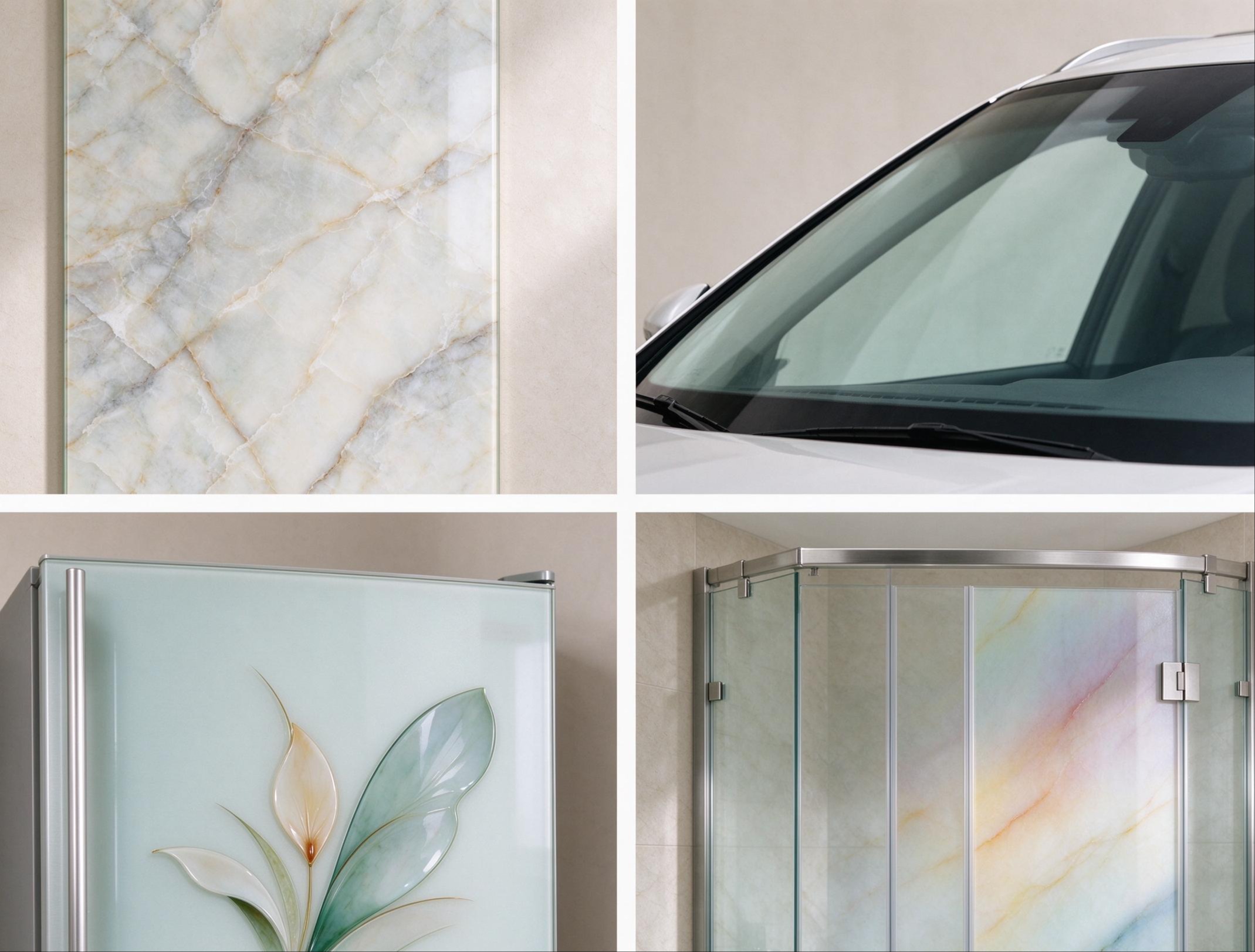
- Architectural and home glass: curtain-wall ceramic frit, interior partitions and art glass, enabling stone-like textures, wood grains, gradients and custom continuous patterns;
- Automotive glass: black frit light-blocking layers on windshields and side windows, brand logos and marking characters (black frit also serves the functions of light blocking and protecting the sealant layer, making it a combined decorative and optical application);
- Glass panels for home appliances, bathroom products and furniture: customized patterns and markings for refrigerators, ovens, shower room surfaces and decorative coffee tables.
For such applications, digital inkjet printing effectively compensates for the shortcomings of traditional screen printing: there is no need to repeatedly make screens, design changes only require replacing the file, and natural random textures and soft gradients can be easily achieved, meeting today’s demand for high-mix, low-volume orders.
III. Functional Layer: An Incremental Blue Ocean That Inkjet Printing Is Penetrating
If the decorative layer “gives glass appearance,” the functional layer gives glass performance—and it is also the current main growth line of the industry.
These applications do not prioritize appearance. Instead, by precisely depositing functional pastes, they build coatings with electrical, frictional and optical properties in designated areas. Traditional screen printing, full-surface magnetron sputtering and sandblasting often suffer from material waste, difficult design changes and limited pattern precision in these applications. The main implementation directions include:
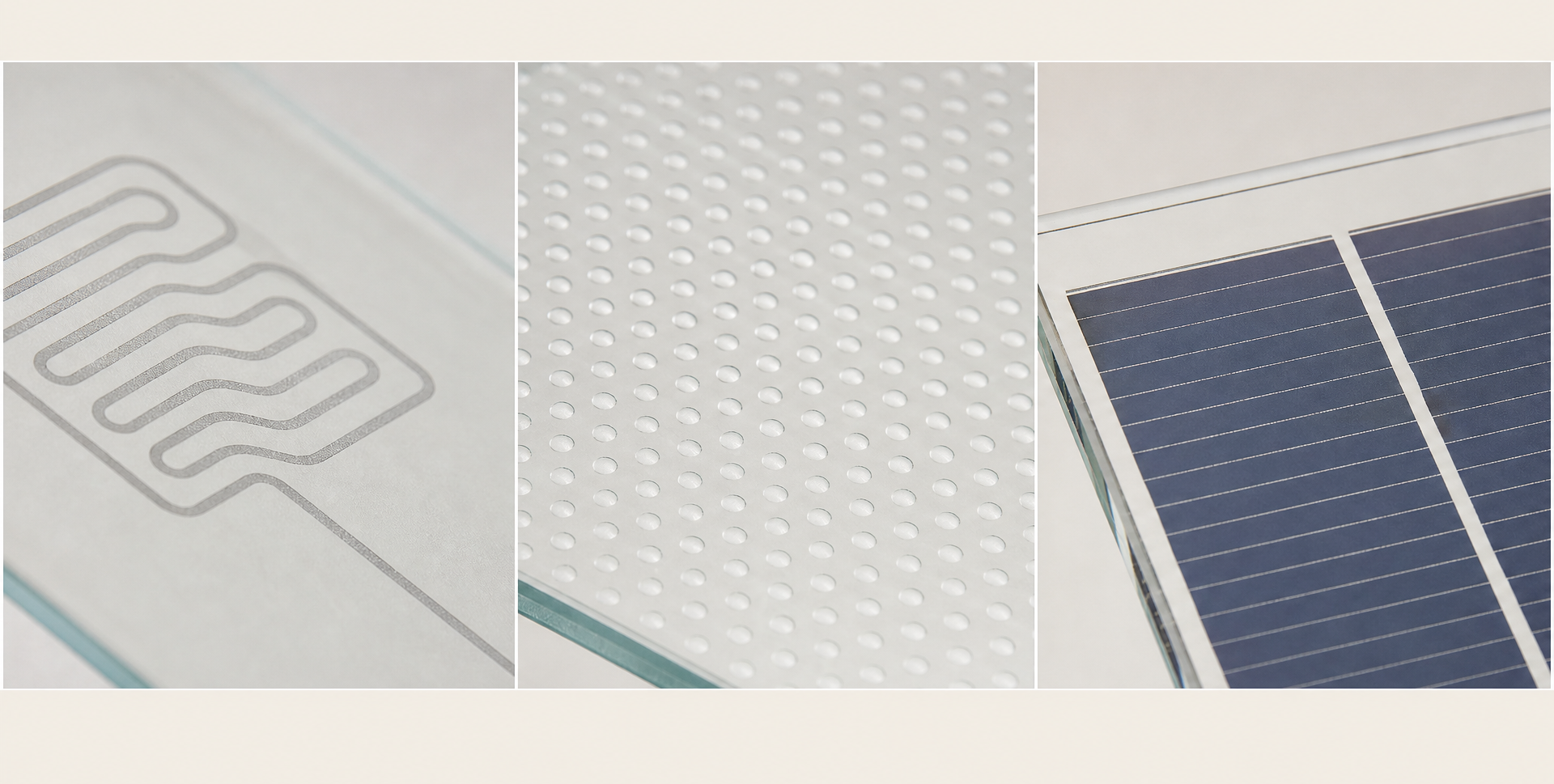
- Conductive functional layer: nano-silver heating wires, high-frequency conductive patterns such as automotive antennas, and localized transparent conductive patterns; defrosting/heating grid applications on automotive rear windows; automotive antennas and localized conductive patterns in photovoltaic and touch-control fields. The value of inkjet lies in finer line widths, greater pattern freedom and the potential to adapt to high-frequency performance;
- Anti-slip and wear-resistant dot matrix: bathroom glass, balustrade glass and step/tread glass, with hard ceramic particles deposited at designated locations and the coefficient of friction controlled by adjusting dot density;
- Optical functional layer: HUD area masking, sensor window shading and localized anti-reflection/diffusion dot matrix, suitable for precision optical applications such as automotive and photovoltaic;
- Frontier exploration directions: high-temperature-sintered site-specific antibacterial and hydrophobic ceramic coatings are still in the validation and early introduction stage; in the dedicated ink market for glass digital printing, the share of functional inks such as antibacterial and self-cleaning inks has been rising rapidly, but achieving stable mass production on glass deep-processing lines by inkjet is still a threshold being crossed.
IV. Digital Inkjet vs. Traditional Processes
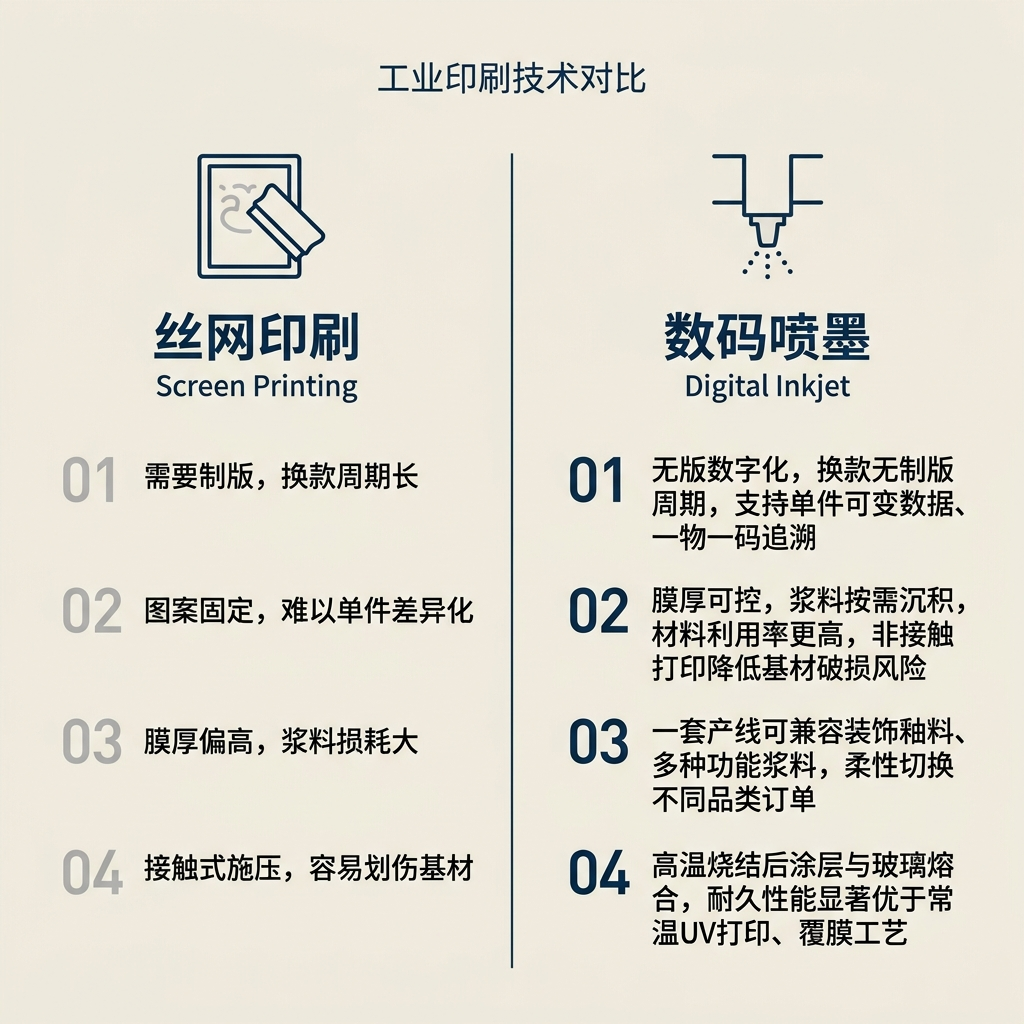
Of course, we are not denying traditional processes: screen printing still has a cost advantage in ultra-high-volume, fixed-pattern orders. The advantages of digital inkjet are concentrated in flexible production scenarios:
- Plate-free digitalization: no plate-making cycle or cost for design changes, with support for single-piece variable data and item-level traceability;
- Controllable film thickness: paste is deposited on demand, material utilization is higher, and non-contact printing reduces the risk of substrate damage;
- One production line can be compatible with decorative glazes and multiple functional pastes, flexibly switching between different order categories;
- After high-temperature sintering, the coating fuses with the glass, providing durability significantly better than room-temperature UV printing and film lamination.
For this reason, the functional layer turns inkjet from “outputting images” into “depositing materials”: the criteria for evaluating a control system are no longer just color accuracy, but whether deposition volume is stable, whether line geometry can be reproduced, and whether post-sintering performance is predictable.
V. How to Select an Inkjet Control Solution for Glass Digital Inkjet Production Lines
Decorative and functional applications have clearly different requirements for inkjet systems: decorative applications focus on color reproduction and color-difference control, while functional applications place greater emphasis on line precision, ink volume stability and parameter reproducibility. In addition to printheads, inks and mechanical motion platforms, the overall inkjet control solution is the core foundation determining process stability on the production line. During selection, the following dimensions should be evaluated with priority:
- Printhead ecosystem compatibility: whether it can adapt to mainstream industrial printheads and, for the settling, agglomeration and abrasion characteristics of solid-particle-containing pastes, provide active ink circulation and printhead health management, rather than relying only on the ink delivery architecture of color decorative inkjet to handle functional pastes;
- High-speed single-pass synchronization capability: hardware encoder-level synchronization, stable high-speed data streaming, and suitability for continuous glass conveying lines;
- Process compensation capability: support for multi-channel color separation and firing color-difference LUT compensation; for functional applications, precise control of ink volume, line width and dot density;
- Automation integration capability: open standardized interfaces, support for connecting to PLC and MES systems, and realization of automatic work order dispatch, single-piece data binding and full-chain traceability;
- Open secondary development capability: comprehensive SDK to help equipment manufacturers encapsulate proprietary process packages based on their own fluid and mechanical processes;
- Supporting process tools: built-in missing-nozzle detection and compensation, printhead status monitoring, and high-speed RIP processing of large-format high-resolution files;
- Compliance and technical support: ability to meet industry standards such as export certifications and automotive traceability, with fast-response local technical service capability.
Digital inkjet for glass is moving from replacing screen printing for decorative patterns toward digital precision material deposition. As inorganic functional ink systems continue to mature, functional-layer applications such as conductive, optical and wear-resistant layers will become the next important growth curve. This flexible digital process also brings glass deep-processing companies new possibilities for differentiated products and high-value-added orders.
Shenzhen Hosonsoft Co., Ltd.
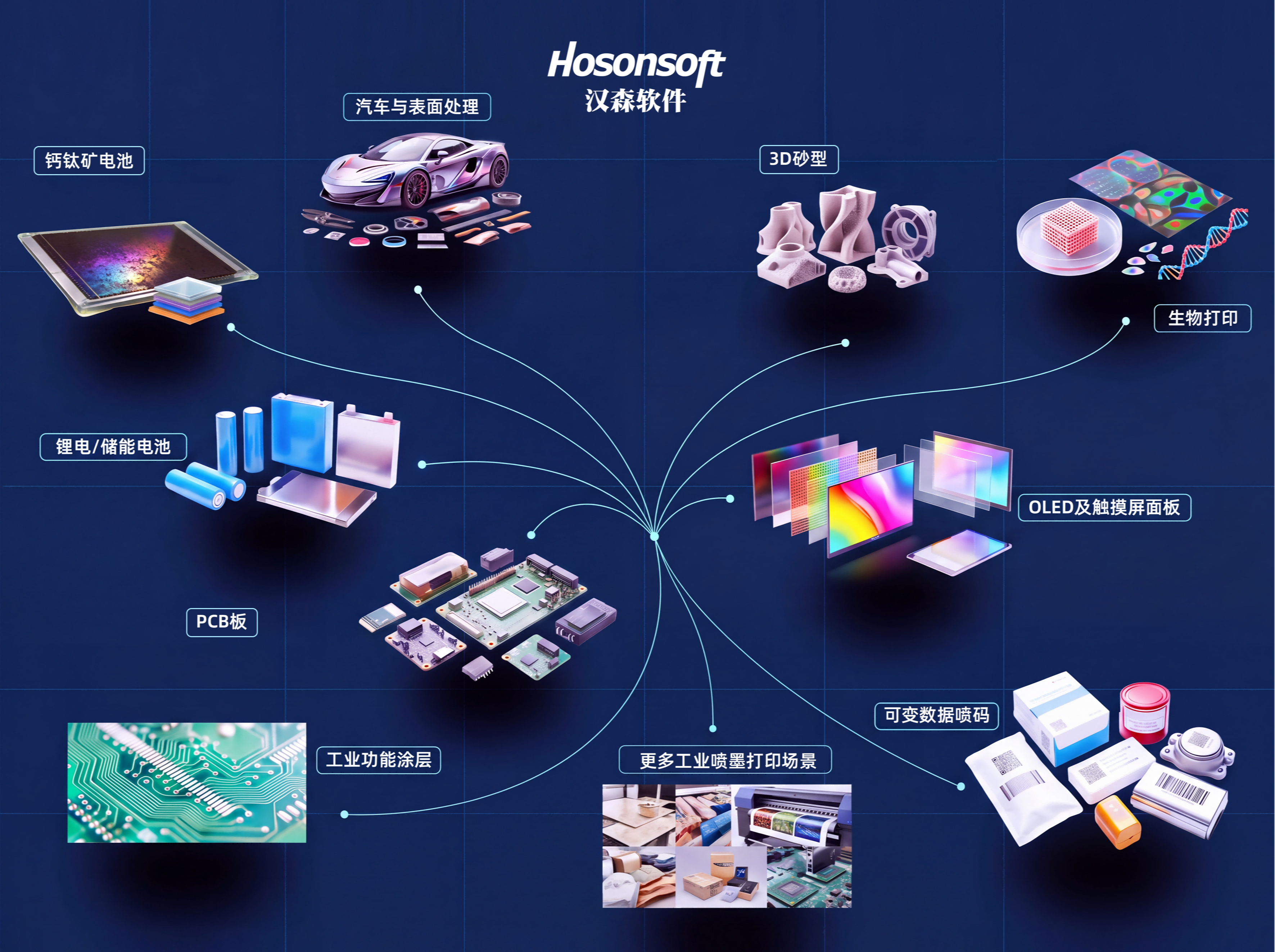
Founded in 2006, the company is a full-chain digital printing solutions provider in the industrial digital inkjet printing field. As the world's largest independent print control system supplier, it focuses on control systems, RIP software, SaaS platforms, and matching inks, building a full-industry-chain layout covering core components, software, cloud services, and consumables. The company holds more than 430 authorized patents, and its business covers more than 100 countries and over 20 industries worldwide. Its solutions have been widely implemented in textile, packaging, 3D printing, advertising, labels, lithium batteries, photovoltaics, semiconductors, biomedical, and many other industries. The company is committed to providing B2B customers with end-to-end, scalable, integrated printing solutions.
 Back


