


 CN


As device spacing continues to shrink and process tolerances move from microns to sub-microns, traditional manual dispensing solutions are beginning to hit rigid bottlenecks. Contact dispensing and non-contact jetting dispensing are becoming preferred solutions for high-precision, high-throughput micro-fluid applications.
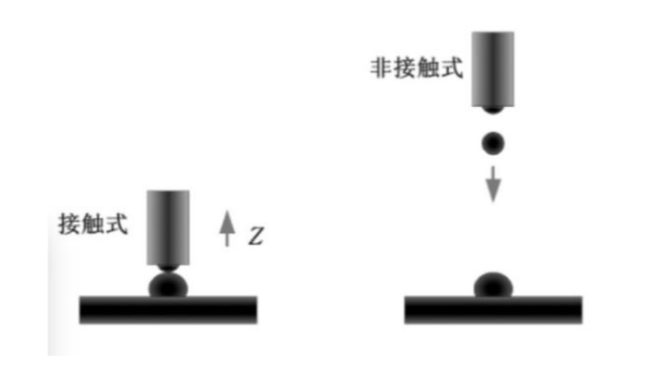
Understanding Precision Dispensing: Process Routes, Choose as Needed
To start with the conclusion: contact dispensing will not be eliminated, but the process requirements of component miniaturization, high-density arrays, and high-throughput mass production are pushing piezoelectric jetting from an optional choice to a necessary one.
Contact dispensing is suitable for particle-containing, highly abrasive, and ultra-high-viscosity fluids. Its equipment hardware and subsequent maintenance costs are low, and it remains a mature, cost-effective, and stable choice in most conventional high-volume dispensing scenarios.
However, it relies on a needle contacting the workpiece to dispense fluid, which can easily crush fragile substrates such as bare chips and thin films. Limited by the minimum needle orifice, it is difficult to stably achieve nanoliter-level micro-dispensing. In long-term mass production, needle wear can cause dispense-volume drift, and defects such as stringing and tailing are difficult to eliminate. Efficiency is also limited in high-density array and high-throughput production scenarios.
To break through these bottlenecks, non-contact jetting dispensing technology has gradually become widespread. Currently, the mainstream routes are divided into pneumatic needle jetting and piezoelectric jetting:
Pneumatic needle jetting: mature for mass production and widely used in medium-to-low precision jetting scenarios;
Piezoelectric jetting (piezoelectric inkjet-style dispensing): relying on high-speed deformation of piezoelectric ceramics to extrude droplets on demand, it does not contact the workpiece throughout the process. It offers fast response and strong droplet controllability, making it an advanced route for micro-precision processes.
Same Technical Origin: Migrating Inkjet Control Capabilities to Piezoelectric Jetting
Piezoelectric inkjet printing and piezoelectric jetting dispensing share the same underlying physics: piezoelectric signals drive ceramic deformation, squeezing fluid to form droplets.
Industrial inkjet printing: aims at area imaging and uniform pattern formation, with media mostly being low-viscosity inks;
Piezoelectric jetting dispensing: outputs single droplets at fixed points and in fixed volumes, pursuing precise placement and consistent dispense volume, and is aimed at various functional process fluids.
The difficulty of piezoelectric jetting lies in stable long-term mass production: suppressing satellite droplets, eliminating stringing, preventing dispense-volume drift, and preventing placement drift.
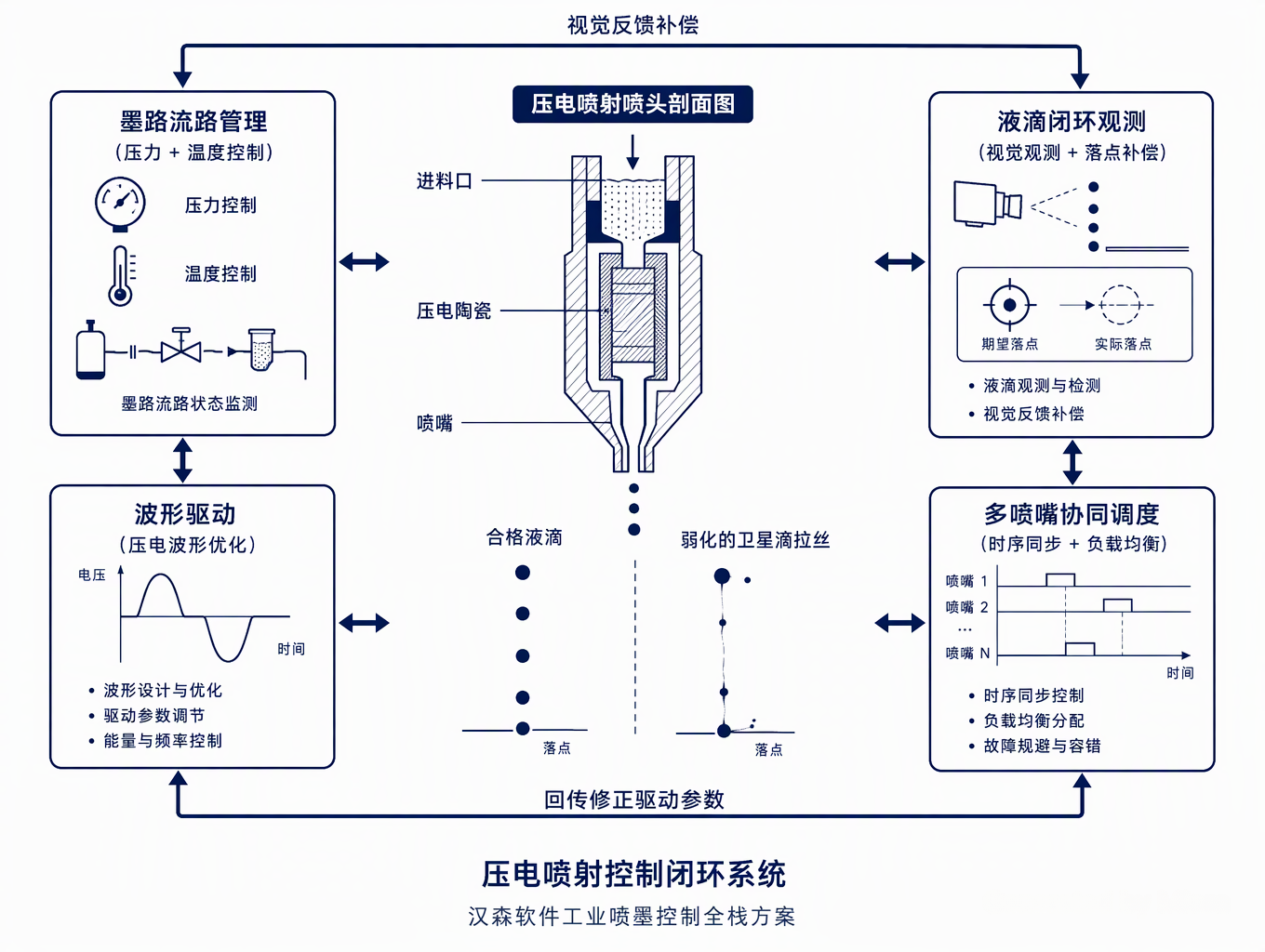
Hosonsoft full-stack industrial inkjet control solution, built on control-layer technologies accumulated over 20 years of mass production, upgrades piezoelectric jetting from "can jet" to "jets accurately and stably." The solution focuses on low-to-medium viscosity precision fluid applications, covering flux, some UV adhesives, low-viscosity underfill, and medium-viscosity silver paste and conductive adhesives. Core capabilities include waveform optimization, closed-loop droplet observation, vision feedback compensation, ink/fluid path management, and multi-nozzle coordinated scheduling:
- Waveform driving and droplet optimization: customize drive waveforms for different fluid characteristics to suppress typical defects such as satellite droplets and stringing;
- Vision feedback and placement compensation: integrate with the vision system to dynamically compensate positional deviation, supporting sub-micron alignment requirements;
- Ink/fluid path management: closed-loop control of pressure and temperature, suitable for functional pastes prone to settling and curing;
- Multi-nozzle coordinated control: precise timing synchronization, supporting high-speed dispensing for large-area, high-density arrays.
- High step-height adaptability: supports 30 mm high step-height printing, meeting the dispensing needs of workpieces with high and low steps.
Value Implementation: Core Scenarios of Piezoelectric Jetting in High-Precision Manufacturing
Different sectors have different requirements for micro-fluid handling. We have summarized the process scenarios that best match the characteristics of piezoelectric jetting:
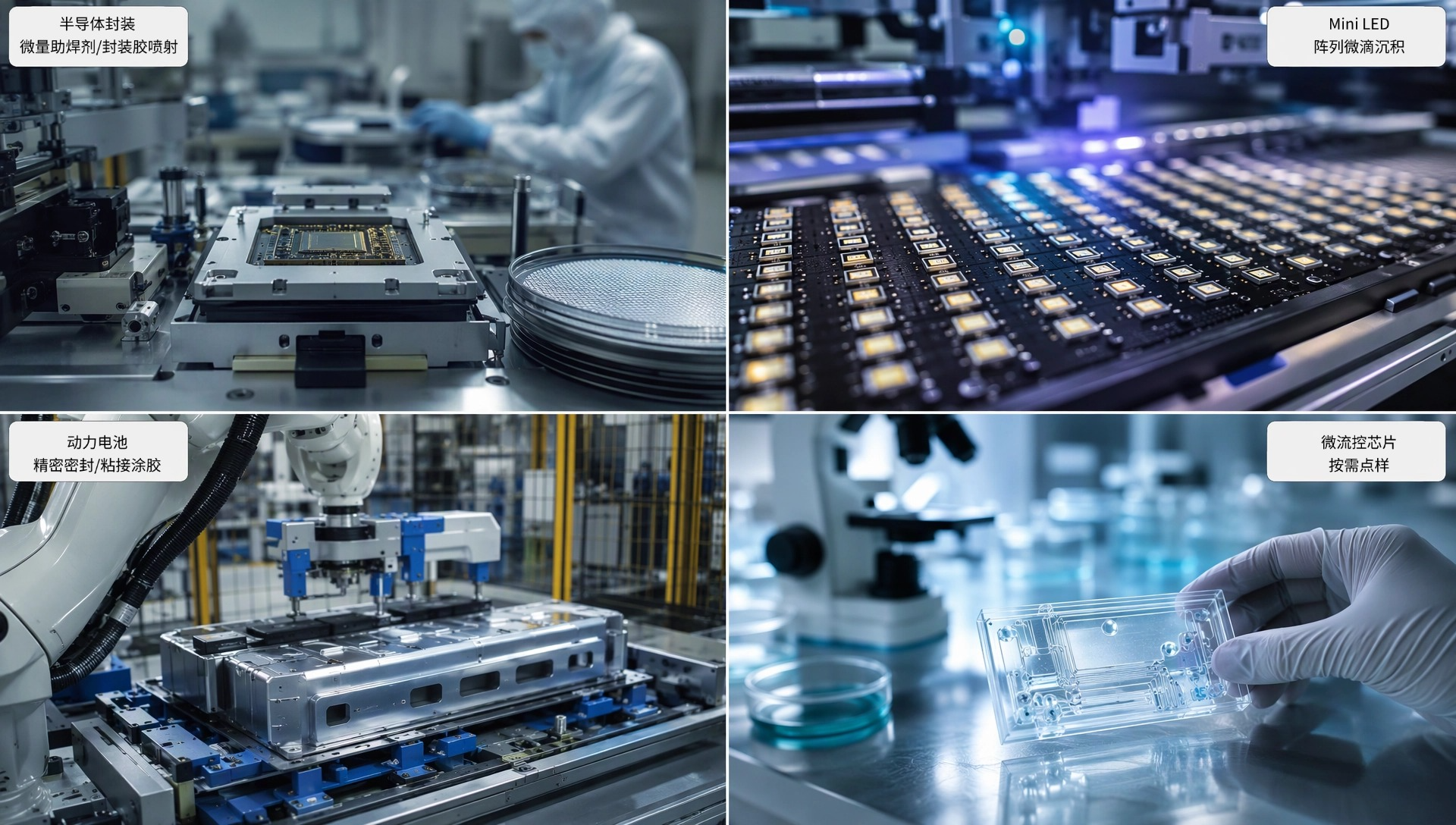
1. Semiconductor Advanced Packaging
This is the application scenario where piezoelectric jetting has the strongest value impact.
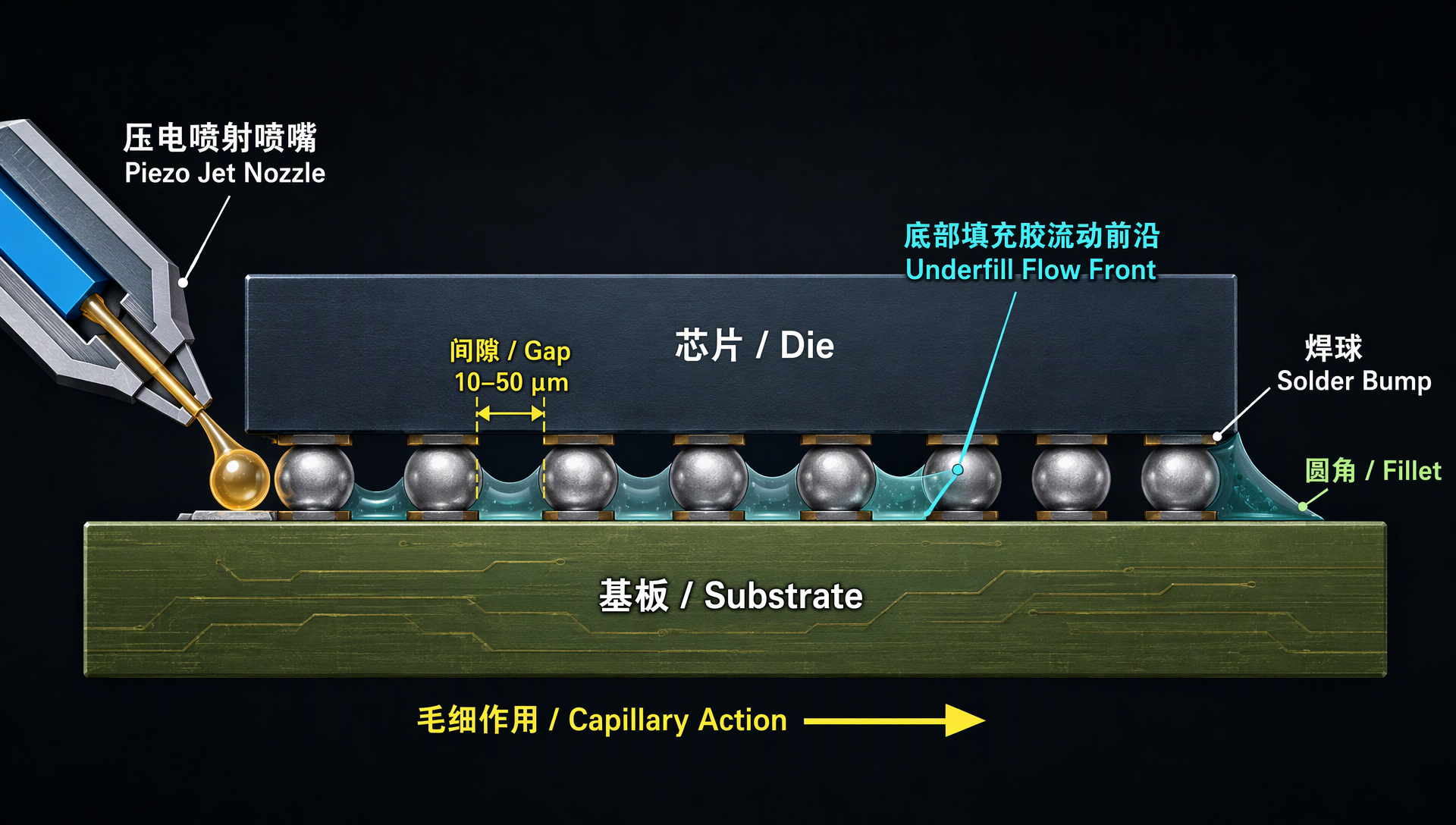
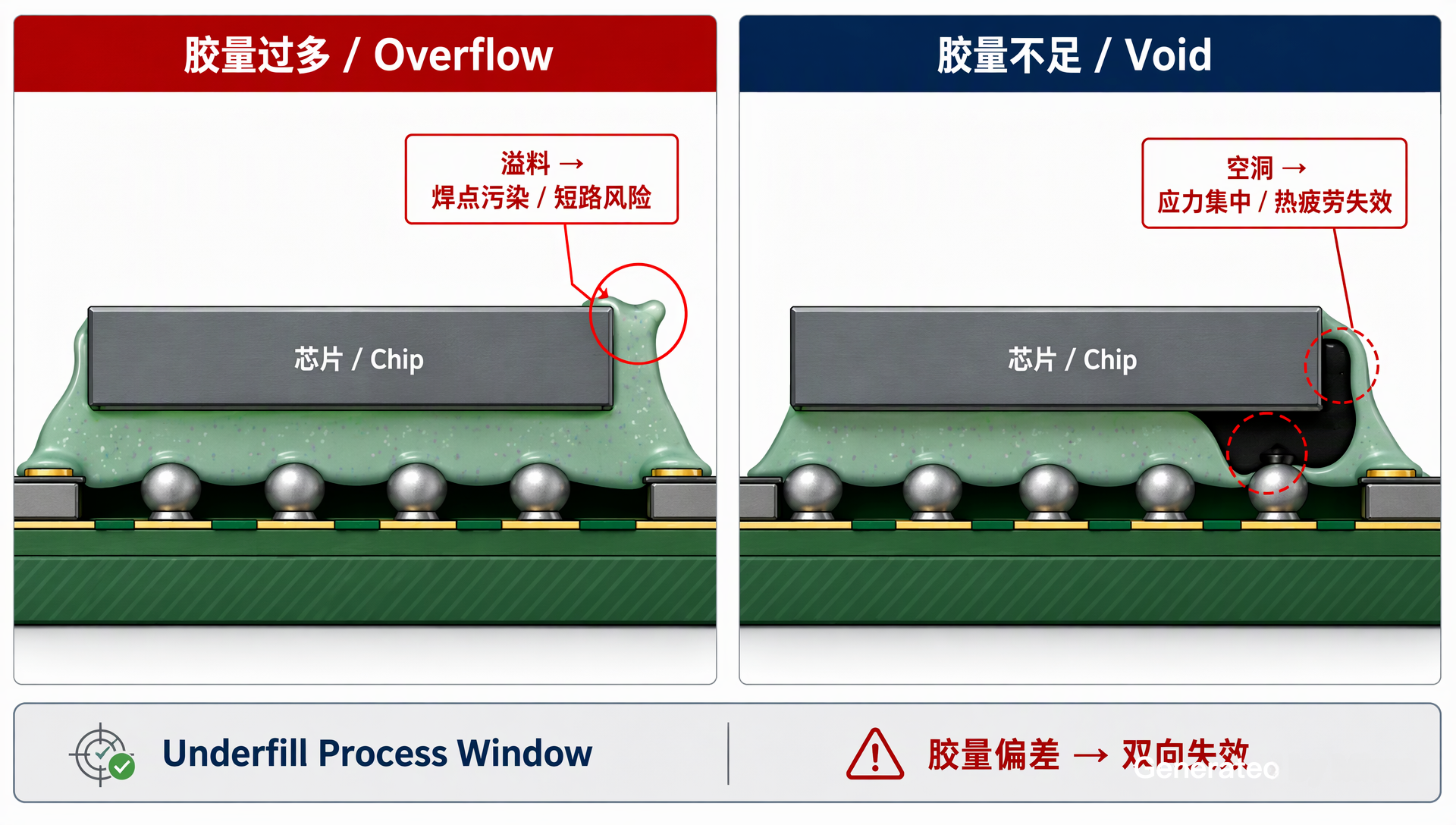
In the advanced packaging Underfill process, the adhesive flows by capillary action into the gap of tens of microns between the chip and the substrate. One extra drop can cause overflow that contaminates solder joints; one drop less can create internal voids and directly cause device failure.
The industry's requirements for dispensing precision are now shifting from micron-level to sub-micron-level. Piezoelectric jetting solutions with nanoliter-level controllable dispense volume and high-precision vision alignment have become mainstream solutions at leading overseas assembly and test houses.
Additional implementation scenarios: chip dam adhesive, micro-deposition of conductive silver adhesive, WLCSP wafer-level packaging, and COB packaging.
2. Display and Optoelectronics: Mini/Micro LED, OLED, and Camera CCM Modules
Mini LED coplanar coating, OLED encapsulation, and camera module dam-and-fill are high-frequency rigid demands in the optoelectronics industry.
These scenarios share prominent common features: tiny dispense dots and stringent placement accuracy; thin, brittle, and easily deformed substrates that cannot withstand contact pressure from a needle. Piezoelectric jetting relies on non-contact droplet flight transfer, fundamentally avoiding the risk of damaging devices under pressure.
3. New Energy: Power Batteries, Photovoltaic Precision Coating and Sealing
Piezoelectric jetting dispensing has entered power battery and photovoltaic manufacturing lines for sealing, bonding, and precision coating.
Power battery sealing life requirements can be as long as ten years, and adhesive bead position and dispense-volume consistency directly determine the long-term reliability of battery cells. In narrow gaps, micro sealing structures, and other positions where traditional contact dispensing is difficult to perform stably, piezoelectric jetting opens a completely new process window.
4. Biomedical and Microfluidics
Applications cover microfluidic chip fabrication, diagnostic reagent array spotting, and precise drug delivery.
The channel dimensions of microfluidic chips themselves are on the micron scale, requiring nanoliter or even lower-volume droplets for on-demand, micro-volume, non-contact deposition. The underlying control logic is highly consistent with piezoelectric inkjet.
5. PCB and Electronics Assembly
High-density micro solder joint scenarios such as BGA micro flux jetting, micro-pad flux, and FPC reinforcing adhesive are also mature implementation directions for piezoelectric jetting, aligning with the trends of PCB miniaturization and high-density routing.
Below the Micron: Nanoliter Dispensing, New Infrastructure for Advanced Packaging
Contact dispensing and piezoelectric jetting are not about one replacing the other; they are two complementary technical systems for different working conditions. Facing new manufacturing requirements such as component miniaturization, high-density layout, and long-life reliability, piezoelectric jetting continues to expand the boundaries of precision fluid processes through control logic that shares the same origin as industrial inkjet.
Hosonsoft looks forward to working with equipment partners to apply its inkjet control capabilities accumulated over twenty years to precision dispensing processes, jointly seizing the opportunities brought by the upgrading of fluid processes in advanced manufacturing.
If you would like to learn more about the solution details, you are welcome to contact us for further discussion.
Shenzhen Hosonsoft Co., Ltd.
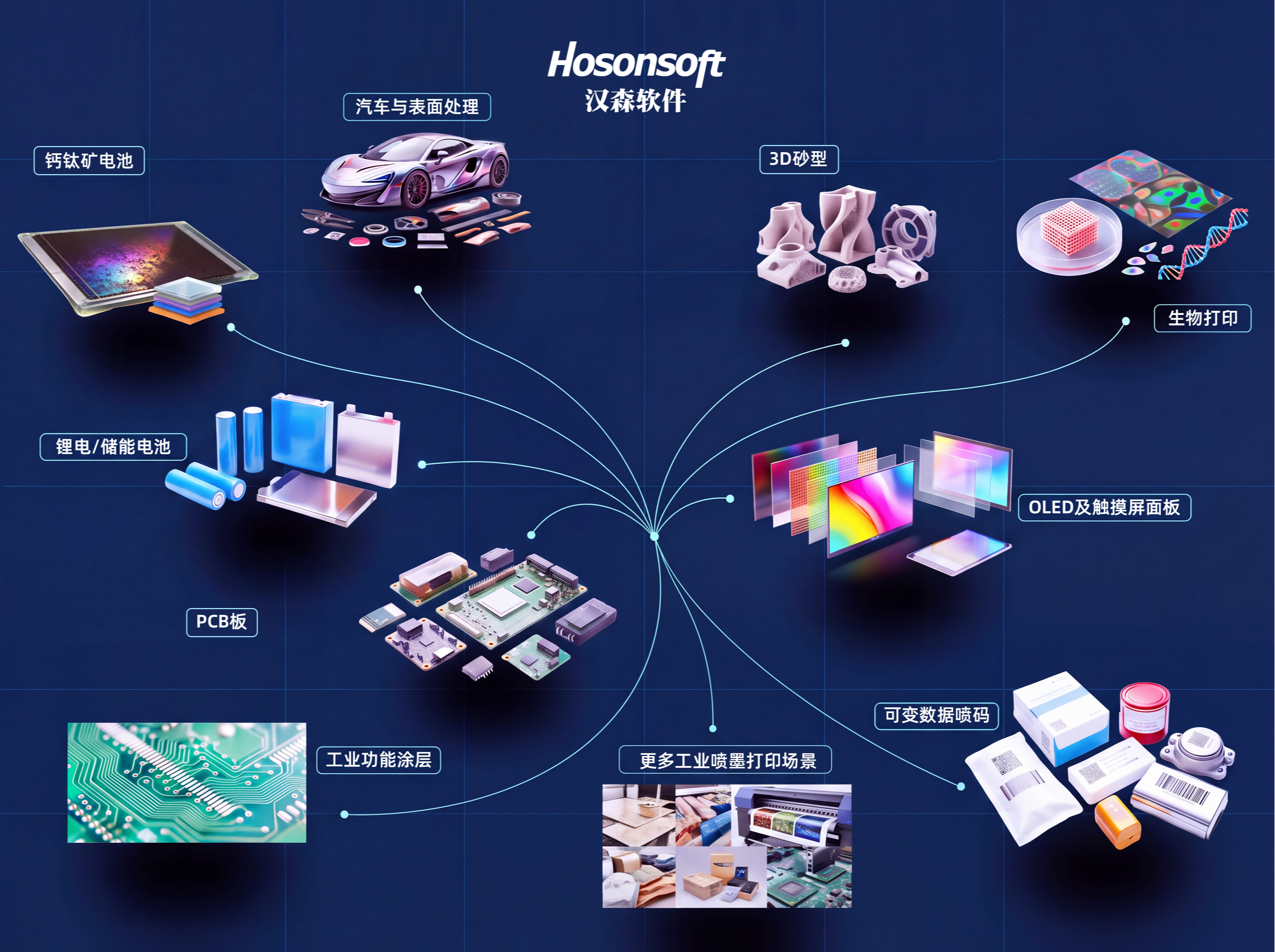
Founded in 2006, the company is a full-chain digital printing solutions provider in the industrial digital inkjet printing field. As the world's largest independent print control system supplier, it focuses on control systems, RIP software, SaaS platforms, and matching inks, building a full-industry-chain layout covering core components, software, cloud services, and consumables. The company holds more than 430 authorized patents, and its business covers more than 100 countries and over 20 industries worldwide. Its solutions have been widely implemented in textile, packaging, 3D printing, advertising, labels, lithium batteries, photovoltaics, semiconductors, biomedical, and many other industries. The company is committed to providing B2B customers with end-to-end, scalable, integrated printing solutions.
 Back


